The European Union’s Carbon Border Adjustment Mechanism (CBAM), which converts embedded emissions1 into costs assigned to imported goods, moved out of its trial period in January 2026. As a result, carbon intensity now has a direct effect on landed costs (the total cost of shipping products from their origin to their final destination)—and therefore on margins.
This article provides a factual overview of CBAM and looks at both how CBAM is likely to affect companies and, against the current backdrop of high geopolitical and economic uncertainty, how companies can manage these impacts.
CBAM requires emissions data to be verified by an independent third party and imposes reporting requirements (see sidebar, “MRV and trade implications”). Where CBAM declarations cannot provide data that an EU-accredited auditor has verified, the European Union will apply conservative default values.
While CBAM poses a number of challenges for affected companies, the granular data that companies will gain through CBAM submissions could also enable companies to undertake targeted actions to decrease carbon intensity—and therefore costs. Value creation opportunities include helping improve decision-making around factors such as supplier allocation, product specifications, and contracting and pricing mechanisms. Companies could also mitigate exposure and manage cost volatility through financial and commercial mechanisms such as hedging approaches linked to European Union Allowance (EUA)2 or CBAM certificate prices.3
Why CBAM matters: Carbon intensity as trade variable
CBAM is designed to reduce carbon leakage4 by aligning the carbon cost of certain imports with the cost EU producers face under the EU Emissions Trading System (EU ETS). As a result, the policy affects three main groups of companies: non‑EU companies exporting to the European Union, EU producers of CBAM‑covered goods, and EU importers of CBAM‑covered goods (often downstream manufacturers).
This article focuses on EU importers and downstream users, for whom CBAM becomes a new component of landed costs. Take imported steel as an example: CBAM increases the carbon-related cost, much of which is passed through into higher prices for buyers. These higher prices then cascade through the value chain, raising costs for downstream industries such as automotive and construction while shifting demand toward lower-carbon producers. Carbon intensity has therefore become an explicit trade variable, directly affecting costs and reinforcing the need for companies to systematically track, verify, and manage emissions data.
CBAM also presents several additional challenges for affected companies. In addition to increased costs and supply chain pressures, complying with CBAM is complicated by the limited availability of verified emissions data. Evolving methodologies for calculating CBAM-related costs and carbon price volatility also complicate financial forecasting. For many companies, the capabilities required to manage these issues are still nascent, leading many to focus on just compliance rather than active exposure management.
Cost implications: How verified emissions data can reduce CBAM costs
In addition to the decarbonization-related benefits, companies that use verified emissions data to actively manage CBAM exposure can create substantial value. Research shows that verified emissions data across various country or product cases can reduce CBAM costs per metric ton by 30 to 85 percent before decarbonization measures (such as switching to renewables) are put in place.5
CBAM liability is based on three inputs:
- certificate price (linked to the EU ETS or EUA price)
- import volume
- net emissions obligation per metric ton (embedded emissions net of both applicable CBAM benchmark and recognized carbon costs paid in country of origin)
In practice, companies typically have the most control over the third input. CBAM encourages producers and importers to measure and reduce emissions by rewarding low-carbon production with lower costs. As a hypothetical example, consider 5,000 metric tons of tool steel imported from China: Carbon costs could be nearly €2.0 million under default assumptions, compared with €0.72 million using verified data—a 63 percent reduction (Exhibit 1).6
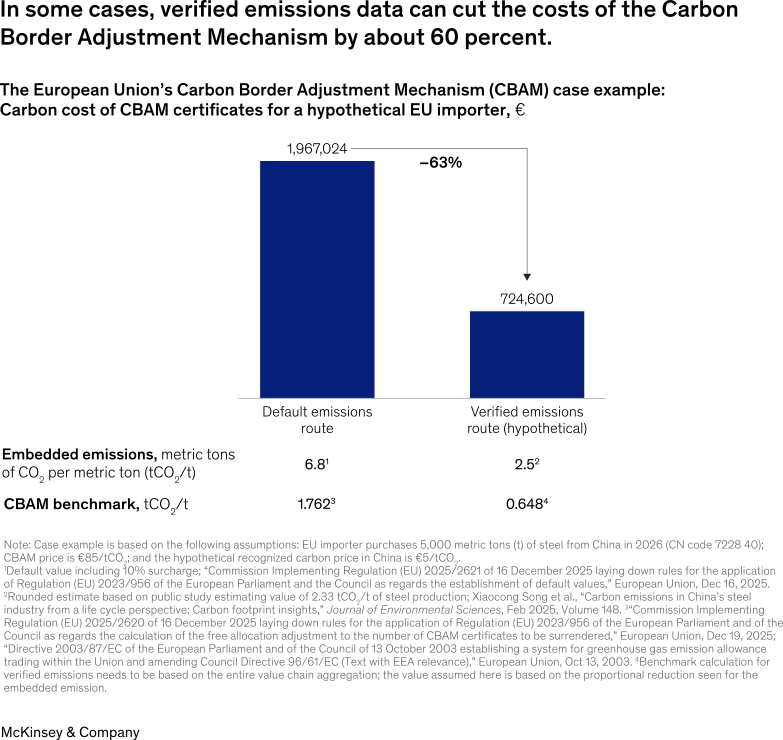
These potential savings are not unique to a single case example. Moving from default factors to verified “real emissions” across a broad set of steel archetypes by country or region could materially reduce CBAM costs per metric ton, depending on the origin footprint and benchmark treatment.
This reduction is driven by two mechanisms embedded in the policy: First, default values are intentionally conservative to encourage robust monitoring, reporting, and verification (MRV), which means that many companies will lower their carbon costs simply through the act of submitting verified data. Second, verified data replaces assumptions with auditable footprints, enabling companies to take action to decrease their carbon intensity and, as a result, their costs.
Scope and timeline: Changes on the horizon
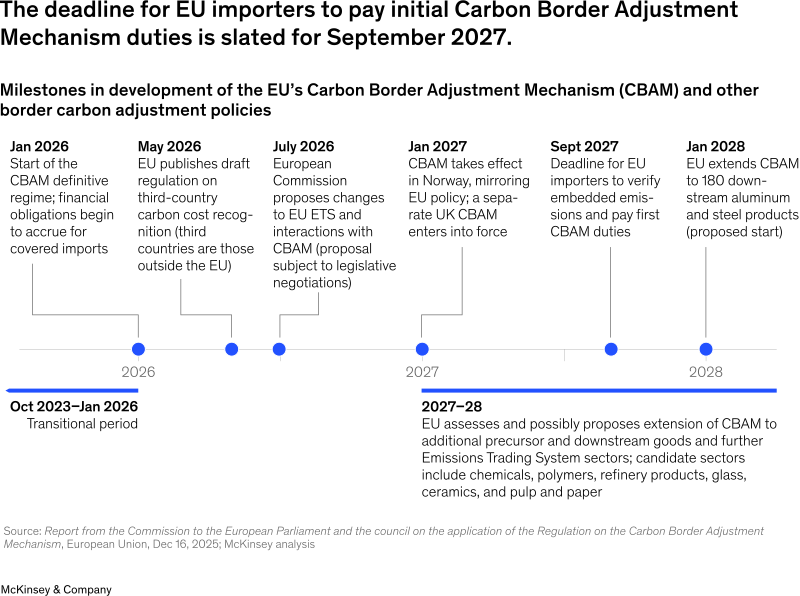
The reporting‑only period for CBAM (final reports were due January 1, 2026) required importers to submit quarterly embedded‑emissions data (Exhibit 2). Looking ahead, the policy is scheduled to transition to financial obligation, with first payments due in September 2027. Recently, the European Commission proposed revisions to the EU ETS, including adjustments to the interaction between EU ETS free allocation and CBAM. While these proposals remain subject to negotiations between EU institutions and won’t affect companies’ near-term compliance obligations, they could influence the pace and design of CBAM implementation over the longer term.7
CBAM has also triggered wider regulatory responses. Some jurisdictions are exploring parallel mechanisms, while others are strengthening domestic carbon pricing to retain carbon‑pricing revenues and reduce CBAM exposure. Globally, 27 national carbon pricing instruments8 and eight border carbon adjustments are under development or consideration in addition to CBAM.9
How to mitigate CBAM risk: A practical playbook
Although the level equation is theoretically simple, cost volatility could occur from changing inputs and regulatory or methodological uncertainty. The following factors could affect the final costs that companies pay:
- Carbon price: Changing EUA prices directly affect the CBAM certificate price.
- Volume and timing: Shipment mix, seasonality, and procurement decisions frequently change exposure.
- Method and interpretation: Evolving guidance on policy scope, allocation rules, and accepted calculation approaches can affect how embedded emissions are reported.
- Benchmark, default, and methodology changes: Benchmark deductibles and default values could be updated as CBAM rules mature.
- Country-of-origin recognition: Uncertainty about eligibility, documentation standards, and enforcement practices can affect foreign carbon costs.
- Data and assurance risk: Incomplete data, failed audits, or restatements can lead to conservative defaults being imposed.
Although many companies are still building basic reporting capabilities, leading players are already using CBAM to reshape sourcing decisions, supplier strategies, and pricing models. Companies looking to minimize costs can deploy a cross-functional playbook spanning compliance, procurement, finance, and commercial.
Compliance: Make moves today to verify emissions data
Data quality is now a direct cost lever, not just a compliance requirement. Companies relying on default values instead of verified data risk systematically overstating emissions and overpaying through CBAM.
Leading companies build a CBAM-ready data backbone that links product codes, supplier installations, process routes, and emissions factors at the required granularity. They also prioritize primary, installation-level data with third-party verification, especially for high-volume and high-intensity categories.
Standardized data packs from suppliers can be put together to cover installation ID,10 methodology, verification status, and carbon price paid while a central data model informs both compliance and landed-cost decision-making. Emissions data can then be integrated into budgeting and CBAM price scenarios. Last, clear governance is likely needed across procurement, tax or customs, and sustainability, including ownership around making the required declarations.
Overall, accelerating verified data remains the most important “no regrets” move because it can directly reduce payable exposure and avoid systematic overestimation.
Procurement: Reduce exposure through sourcing and design
Companies can actively steer demand toward lower-carbon supply where feasible—for instance, electric arc furnace (EAF) steel, higher scrap content, or certified low-carbon production routes. They can also renegotiate specifications and redesign products to reduce material intensity through light-weighting, yield improvements, or substitution.
Leading players use supplier development and long-term offtake agreements to secure scarce low-carbon inputs, such as high-scrap EAF steel or low-carbon aluminum, and lock in volumes ahead of tightening supply. They also maintain dual sourcing strategies to balance cost and risk as well as to navigate the energy transition.
These actions can shift procurement from price comparison to total-cost and carbon-optimized decision-making.
Finance: Manage price and cash flow risk
Because CBAM certificate prices are directly linked to EU ETS prices, companies must contend with both cost volatility and effects on cash flow tied to operations.
Leading players treat CBAM like any other regulated cost driver and combine operational measures with financial and commercial mechanisms:
- Pass-through clauses: linking product prices to CBAM cost and verified emissions outcomes
- EUA indexation: aligning contracts with the carbon price reference used in CBAM calculations
- Budget-hedging strategies: using EUA-linked instruments to stabilize average cost levels11
- Directional or structured hedges: aligning financial positions with expected certificate needs
- Invoice true-ups: adjusting billing for post-verification changes in emissions or recognized carbon price credits
The right approach depends on risk appetite, margin structure, and treasury policy, but integrating CBAM into financial strategy early avoids unplanned volatility and margin erosion.
Commercial: Build a competitive advantage
Companies cannot avoid CBAM, but they can decide whether it becomes a pure cost burden or a source of competitive advantage. Those that move early on data, sourcing, and pricing could potentially avoid overpaying, secure advantaged supply, and translate carbon performance into commercial differentiation. As carbon costs scale through the late 2020s, the gap between who pays more and who pays less could widen significantly.
For many companies, CBAM represents the moment when carbon intensity becomes a tangible cost factor. As carbon pricing becomes embedded in global trade, firms that invest early in MRV capabilities and combine them with procurement, product, and treasury levers could be best positioned to protect margins and capture the competitive advantage.