While mobility changes will vary by geography, our scenarios allowed us to identify some global trends—and one of the greatest relates to private vehicles. By 2035, the share of passenger miles traveled (PMT) in private cars will drop by about 15 percentage points (Exhibit 1). Over the same time, new modes of travel that are barely on the radar now, such as autonomous roboshuttles, will increase their PMT share from 1 percent today to 8 percent. Public transportation, e-scooters, e-bikes, and minimobility—very small three- or four-wheeled cars—could become preferred transport modes, rather than a last resort for people who cannot afford cars. And apps that link different forms of transportation, such as roboshuttles and urban air mobility, could make intermodal journeys more common, since passengers will no longer have to scramble to put a trip together.
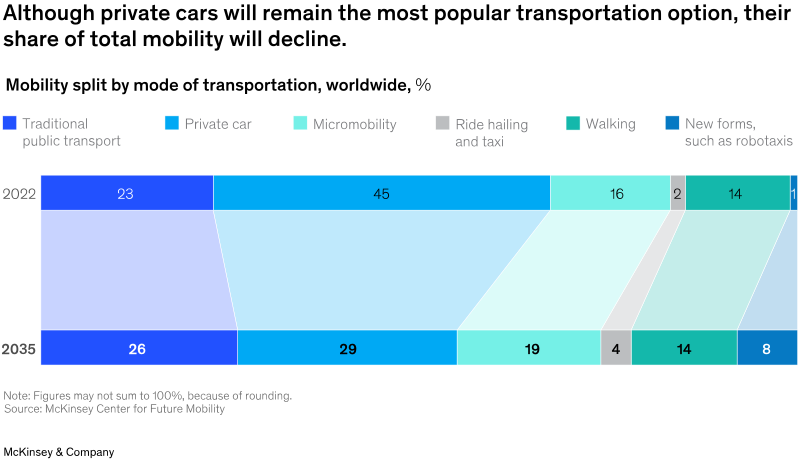
Image description:
A set of horizontal stacked bar charts show the mobility split among six modes of transportation in 2022 and 2035 worldwide. The most prevalent mode in 2022 is private car at 45 percent; it is projected to remain the most used in 2035 at 29 percent. Walking as a share of transportation is projected to stay the same at 14 percent. All other modes are projected to increase by 2 to 7 percentage points from 2022 to 2035. In 2035, traditional public transport is expected to be 26 percent; micromobility, 19 percent; new forms, such as robotaxis, 8 percent; and ride hailing and taxis, 4 percent.
End of image description.
The shifts could come slowly, even in those areas where the change will be dramatic. Over the next few years, most people are likely to continue their usual travel patterns and behavior. The most significant disruptions will likely kick in after that. Urban dwellers in cities such as Los Angeles, Munich, and Shanghai will spur most of the change. Residents of other areas, including rural zones, are less likely to have access to new forms of transportation. The big changes in mobility infrastructure—more bicycle-friendly streets, vertiports for urban air mobility—are also most likely to occur in cities, at least initially. As greener transportation becomes more common, the world may finally begin to see significant drops in emissions.
The changes in mobility will affect everyone from OEMs to ride-share providers. One of the greatest changes will be in the number of private-car sales. Car sales1 will likely rise globally over the next few years and peak by the end of this decade. They could then fall to 84 million units by 2035, down from the 85 million units sold in 2015.
Some regions will likely see bigger drops in car sales than others, which could alter supply chains, sales strategies, and other aspects of the OEM business model. In 2035, for example, car sales in the European Union are forecasted to be almost 20 percent lower than 2015 levels, and the United States could experience an even greater drop of 30 percent. The decrease in cars will have a much more profound impact in the United States than in Europe, which already offers better access to other mobility modes, including public transport. The United States will have to create new infrastructure and increase support for alternative mobility options as private-car ownership drops (Exhibit 2).
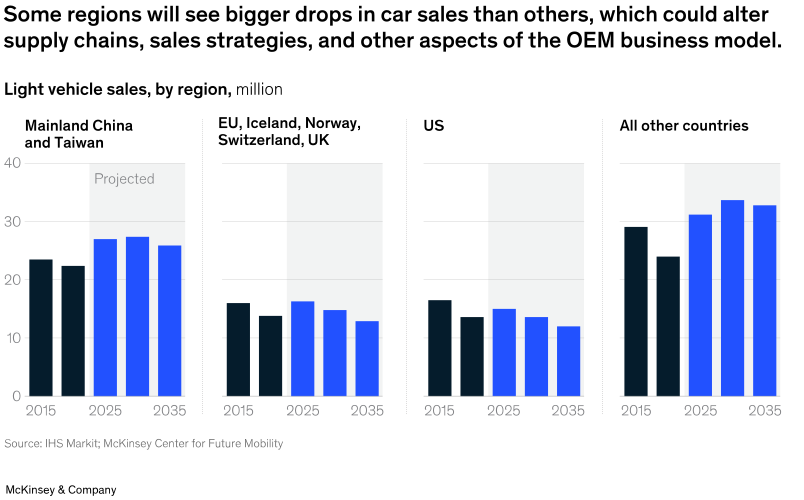
Image description:
A collection of four sets of bar charts shows the number of light vehicle sales from 2015 to 2035 in 5-year increments for 4 regions of the world:
- In Mainland China and Taiwan, sales volume dipped from 23.5 million in 2015 to 22.4 million in 2020. That is projected to increase in 2025 and 2030 before decreasing again in 2035. Compared to 2020, sales are projected to be 16 percent higher in 2035.
- In the European Union, Iceland, Norway, Switzerland, and the United Kingdom, sales volume decreased from 16 million in 2015 to 13.8 million in 2020. That is projected to increase in 2025 before decreasing in 2030 and 2035. Compared to 2020, sales are projected to be 7 percent lower in 2035.
- In the United States, sales volume decreased from 16.5 million in 2015 to 13.6 million in 2020. That is projected to increase in 2025 before decreasing in 2030 and 2035. Compared to 2020, sales are projected to be 12 percent lower in 2035.
- In all other countries, sales volume decreased from 29.1 million in 2015 to 24 million in 2020. That is projected to increase in 2025 and 2030 before decreasing in 2035. Compared to 2020, sales are projected to be 37 percent higher in 2035.
End of image description.
China, which is now an important market for cars, will also likely experience declining sales, although not to the same extent as Europe and the United States. The 26 million units projected to be sold in 2035 will be lower than the historical peak of almost 27 million in 2019, but it will still be above the 2015 level of 24 million.
Some markets, such as India and other parts of South Asia, will partially compensate for the drop in other regions, with car sales expected to continue on an upward trajectory beyond 2035. Total sales in countries other than China, Europe, and the United States, termed the rest of world, are projected to amount to 33 million in 2035. This is up from the 29 million reported in 2015 and slightly above the historic high of 31 million units reported in 2018.
While private customers may show less appetite for new vehicles, technology advances might allow robotaxi and roboshuttle providers to emerge. If so, they might attempt to build their vehicle fleets to capture a greater share of the growing market.
Although car sales may be declining, other value pools are expected to emerge along the entire value chain, potentially disrupting traditional business models. Given the value at stake, as well as the increasing risk of business failure, mobility players should develop a strong future strategy—possibly one that diverges from long-term tactics—to thrive. The question is whether OEMs and others can pivot and scale their operations fast enough.
While new technologies and regulations will account for many shifts, the power of customer preferences—the desire for more convenient and sustainable mobility choices—is equally, if not more, important. For this mobility revolution, the consumer is in the driver’s seat.