Women in the United States face steeper barriers to healthcare than men, causing preventable suffering and costing billions each year. The health of women—encompassing the entire care continuum and extending beyond reproductive and sexual health—represents an approximately $50 billion missed annual opportunity for health systems1 nationally. Addressing the gap in women’s healthcare requires a fundamental transformation in care delivery, with preventive care playing a pivotal role to ensure accessibility, continuity, and comprehensive care.
The McKinsey Health Institute (MHI) and the World Economic Forum (WEF) have published two seminal reports on women’s health that reveal stark disparities between men and women. For example, women in the United States spend 25 percent more time in poor health than men do. Popular discourse often narrowly defines women’s health as reproductive health, but sexual and reproductive health accounts for less than 5 percent of women’s health burden. The remaining 95 percent stems from other health conditions. MHI and WEF’s most recent report provides a blueprint for closing the women’s health gap, urging clinical-care organizations2 to count, study, care for, include, and invest in women (see sidebar “Terminology used in this article”).
Drawing on this research, this article lays out a win–win scenario for women and health systems by highlighting key actions that health systems can take to invest in the health of women. The first action involves ensuring women receive evidencebased preventive care, while the second focuses on reducing turnover of women providers and nurses, as retaining women clinicians is economically advantageous and gender-concordant care has the potential to improve women’s health outcomes3 by enhancing care continuity (see sidebar “Research methodology”). Addressing just preventive care and nurse retention represents an approximately $50 billion annual opportunity nationally. Another critical avenue to improve the health of women is to increase women’s engagement within one health system, but this cannot be summed at the national level, since one provider’s gain could be another’s loss (see sidebar “Enhancing women’s engagement is a $40 million to $150 million opportunity for a midsize health system”).
Improving women’s preventive care is an up to $38 billion revenue opportunity for health systems
Enhancing women’s engagement is a $40 million to $150 million revenue opportunity for a midsize health system
Fragmented care can result in poorer health outcomes for women and lead to missed opportunities for health systems. By comprehensively managing the health of women, health systems could improve the patient experience and their organizations’ financial performance.
Women are more likely than men to seek care across multiple care organizations, often due to dissatisfaction with their healthcare experiences, according to our research. This fragmentation disrupts continuity of care and shifts revenue from one system to another. In fact, our research shows that much of this revenue shifts to providers who do not operate within a health system.
We analyzed share-of-care data—how much of an individual’s total healthcare spending is captured by a single health system versus being spread across multiple care organizations (including both competitor health systems and independent ambulatory providers). For example, one midsize health system1 consistently captured 18 percent of men’s healthcare spending but only 15 percent of women’s (exhibit). Matching men’s engagement rate in just ten common procedures could yield more than $40 million in additional annual revenue for this health system, or a 0.6 percent Net Patient Services Revenue (NPSR) increase; closing the gap entirely would represent a $150 million opportunity, or a 2.5 percent NPSR increase, according to our research.
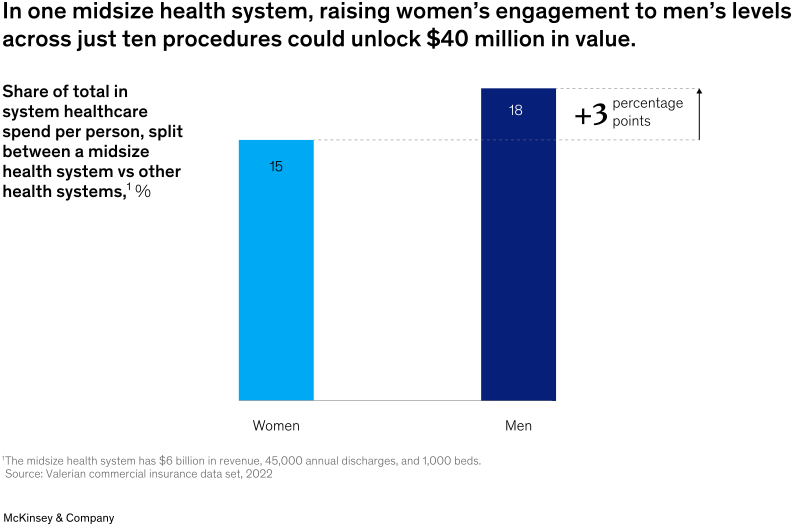
n fact, lower share of care may partly result from disrupted end-to-end care within a health system for a single health issue. Another way to evaluate this disruption is by looking at share-of-wallet data, which describes how much of a patient’s spending for one episode occurred within a health system. As an example, the midsize health system saw a 20-percentage-point lower share of wallet for preoperative and postoperative hip replacement care for women compared with men.2 This demonstrates the substantial value that can be gained by health systems that focus on improving access, continuity of care, and experience.
Another key indicator of care fragmentation is the shifting relationship women have with physicians throughout their lives and their changing needs. During pregnancy, women see ob-gyns often but engage with primary care physicians (PCPs) minimally. During reproductive years and outside of ob-gyn care, women have relatively low healthcare spending (approximately $2,800 per member per year [PMPY]).3 Once childbearing years end, engagement with ob-gyns drops substantially (from an average of about 6.0 visits per year during pregnancy to just 0.3 visits per year during menopausal years), but engagement with PCPs does not increase to keep up with women’s changing healthcare needs.4 For many women, the maternity journey—including the fertility, pregnancy, and postpartum periods—is the most intense time of engagement they’ve had with the healthcare system. Additionally, for many, the birth of a child is a joyous, emotional, and memorable event. Some health systems have chosen to double down during this experience—even though labor and delivery is typically one of the lowest-margin service lines—as an opportunity to deliver a highly positive experience to women patients in an effort to create lasting loyalty for the woman and potentially her broader family.
Middle-aged women are also particularly underserved. During peri- and menopausal years (age 45 to 64), women shift toward chronic-condition management, spending approximately $7,000 PMPY—a 150 percent increase over spending during reproductive years. Spending continues to increase, with women aged 65 years and over spending more than $10,000 PMPY.5 Women’s needs change meaningfully over their lives—from premenstrual health to chronic-condition management—but care models fail to keep up with these changes, leaving women without consistent physician relationships that meet their needs.
Health systems that invest in women-centric primary care have the potential to build lasting patient relationships. By ensuring that women have strong PCP relationships early in their lives, that those PCPs coordinate with ob-gyn care and other provider specialties during reproductive years, and that they can seamlessly address women’s care needs in their postreproductive years, health systems can increase patient engagement, increase share of care, and improve long-term health outcomes.
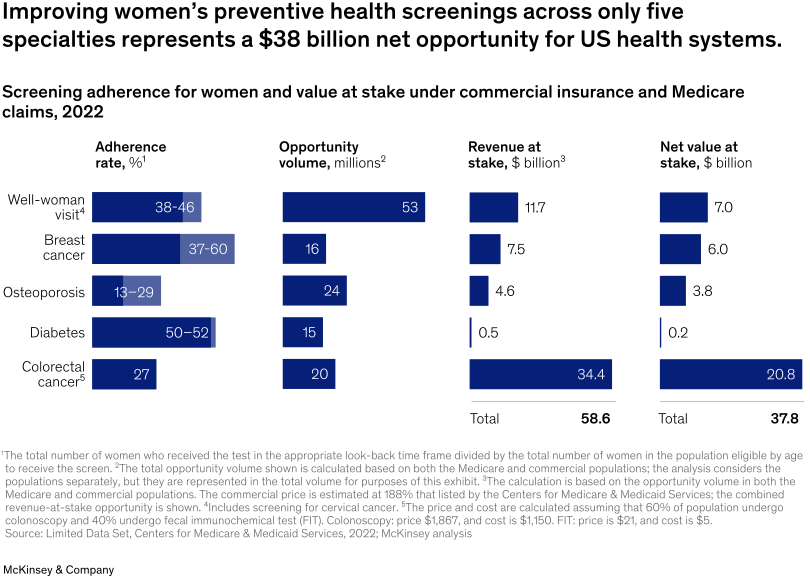
Despite seeing clinicians more often than men, women often don’t get the preventive care that they need.4 By delivering preventive care aligned with clinical guidelines for women, health systems nationally could close the gap of roughly 130 million missed screenings across just five settings and generate up to $59 billion in new annual revenue (exhibit). Even considering the operational costs related to administering the additional screenings required to close the gap, the net value at stake for US health systems is almost $38 billion. This estimate does not account for 1) the additional, much larger revenue potential for health systems that perform treatments in response to positive results identified by screenings, or 2) how additional healthy life years for millions of women could benefit the economy, or 3) the savings potential across the healthcare ecosystem from addressing health concerns earlier in the course of the disease.
Treatment for acute myocardial infarction
Beyond prevention, timely treatment remains an issue, with women more often than men not receiving the full course of recommended treatments for various conditions. At a midsize health system,1 for example, only 40 percent of women who had acute myocardial infarction (AMI) symptoms visited a primary care physician (PCP) compared with 50 percent of men (exhibit). Of those tested for AMI, a smaller share of women than men went on to receive percutaneous coronary intervention and were referred to cardiac rehabilitation afterward. This equates to roughly 25,000 missed AMI interventions for women annually, with women aged under 55 experiencing an 84 percent higher AMI-related mortality rate than men, according to our analysis.
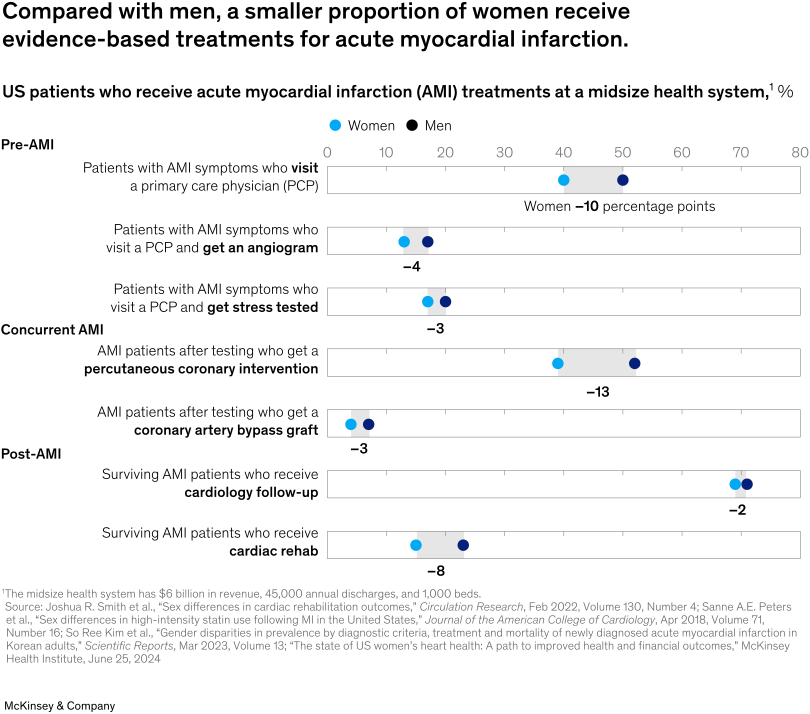
Beyond the missed financial potential, the failure to provide timely preventive care increases women’s disease risk and can lead to costlier, more complex interventions down the line. In fact, women are less likely than men to receive the full course of recommended treatments for various conditions, often as a result of missing key preventive-care opportunities (see sidebar “Treatment for acute myocardial infarction”).
Women face multiple barriers to preventive care. A major issue is the lack of consistent primary care providers (PCPs), which reduces the likelihood of receiving routine screenings and early interventions.5 Cost concerns further discourage preventive visits for women,6 and the disproportionate burden of caregiving for elders and children often keeps women from prioritizing their own health.7
Health systems and other care providers have the unique ability to address these barriers. Telehealth, which women use more frequently than men, has expanded access to preventive care, allowing clinicians to reach those who might otherwise forego screenings. Technology-enabled screening tools, such as AI-assisted mammograms, are improving the effectiveness of screenings, reducing unnecessary secondary screenings and biopsies, and potentially increasing screening rates over time.8 Tools such as these demonstrate how providers can spur system-level change by improving preventive care.
Increasing retention among women nurses represents up to $12 billion in savings and can bolster women’s care
Women are less satisfied at key points in their healthcare journey compared with men.9 A common reason for their dissatisfaction is a feeling of being dismissed by their doctors. For ob-gyn care, for example, women who felt listened to “all the time” were more likely to have a postpartum medical visit and less likely to have postpartum depressive or anxiety symptoms.10 Moreover, the influence of women’s healthcare experiences can extend well beyond their own care needs, as women act as hubs of healthcare decisions. Our research shows that women make 80 percent of healthcare decisions for their households, so improving their experiences with health systems is critical.
One vital way to address dissatisfaction among women is to recruit and retain diverse women nurses, physicians, and allied health staff. Care from women nurses, clinicians, and medical staff has the potential to improve overall health outcomes. Men and women patients both have lower mortality and readmission rates when treated by women physicians compared with those treated by men, according to one study.11 Additionally, the benefit of receiving treatments from women physicians is larger for women patients than for men patients, the study revealed. Another study found that women with heart attacks who are treated by men doctors have higher death rates.12 A third study showed that people are more likely to get recommended cancer screenings when they have a gender-concordant doctor.13 Yet another study focused on diabetes and cardiovascular disease (CVD) concluded that patient and physician gender and gender concordance are modestly linked to CVD risk factor control and treatment in diabetes.14
However, turnover among women healthcare professionals is higher than it is among men. Among registered nurses (RNs)—a largely women’s profession—the net turnover cost for a bedside RN in 2024 was $61,110 in temporary overtime, critical staffing pay, and travel and agency costs to fill the gap.15 Based on the average turnover rate across nurse tenures of 16.4 percent in 2024, the average hospital16 loses between $3.9 million and $5.7 million per year.17 If hospitals nationally reduced nurse turnover by just five percentage points, they could save up to roughly $12.22 billion annually and in the process, potentially improve women’s health outcomes. Given that best-in-class nurse turnover is roughly 5 percent per year,18 achieving an 11 percent turnover is reasonable for many systems if these issues are addressed.
It is important to note that the gender disparity extends to physicians as well.19 Women comprise only 38 percent of active physicians, with even lower representation in specialties such as cardiology (15 percent) and interventional cardiology (5 percent).20 In surgical fields, women represent 6 percent of orthopedic surgery, 8 percent of thoracic surgery, and 15 percent of vascular surgery.21 In a McKinsey survey of RNs, advanced practice professionals, and doctors, almost 45 percent more women than men say they are unlikely to stay with their employer for the next year (13 percent versus 9 percent).22
Addressing the health of women is a win–win for women and health systems
Health systems and other care providers have a unique opportunity to improve outcomes, access, and experience for women while also enhancing their organizations’ financial sustainability. Quick successes may include, for example, introducing concierge care to schedule pre- and postprocedure visits in advance for women with a planned procedure. It may also involve creating better environments for women doctors, nurses, and clinical staff to improve representation in their workforces—from offering flexible workplace options to strengthening the skills of current women employees. Medium-term changes may seek to increase education in residency and fellowship programs on sex-based differences to close the care gender gap. Aspirational goals, accomplishable in five or more years, may include shifting the focus of centers of excellence from women’s reproductive and sexual health to the overall health of women by establishing multidisciplinary care teams.
Academic medical centers specifically—with their tripartite missions of education, research, and care delivery—can modernize medical education and residency curricula to incorporate sex-informed care and prioritize research that disaggregates clinical trial data by sex to improve efficacy and safety. Health systems can also partner with women-focused technology and complementary-care delivery companies to close care gaps.23
By improving evidence-based preventive care, supporting a diverse workforce, and enhancing women’s engagement within a health system, providers can spark meaningful improvements in the health of women while strengthening their own financial performance. Investing in women is not just an ethical imperative—it’s a business imperative and a strategic necessity for the future of healthcare.