Health systems globally are under pressure, facing workforce shortages, rising costs, and uneven access. Low- and middle-income countries (LMICs) are particularly exposed due to a 44 percent decline since 2022 in health-related official development assistance, which is straining already limited budgets.
Digital health1 solutions cannot solve every problem, but they can help address these challenges, enabling faster, more consistent care, especially for those living far away from hospitals or health centers. Scaling digital health solutions is one way to expand healthcare worker capacity and could reduce health system costs in LMICs by up to 15 percent, depending on the implementation and use cases.2 Examples already show promise: In Tanzania, Afya-Tek supports about 450 health workers providing digitally enabled healthcare services to over 375,000 people, while Unity Health Toronto in Canada is working with Signal 1 to develop and scale an AI-based patient monitoring solution, CHARTWatch.3 Most importantly, digital health solutions may help save lives: The World Health Organization (WHO) estimates that each additional $0.24 per patient per year invested in digital health could save more than two million lives from chronic diseases.4
However, digital health adoption remains limited. Many health systems lack the infrastructure, capabilities, and financing to sustain digital health at scale.5 Private sector engagement can play an important role in advancing digital health (for more on the definition of private sector, see sidebar “Terminology”). Among LMICs, engaging the private sector is essential, as they are often responsible for 40 to 60 percent of healthcare spending.6 Globally, private sector actors can often offer solutions that patients and caregivers feel immediately, such as extra capacity, sharper logistics, and user-focused innovations, all of which complement the public sector’s scale and trust. They are also a source of financing, with global private sector investment in digital health reaching $25.1 billion in 2024, growing 5.5 percent annually.7
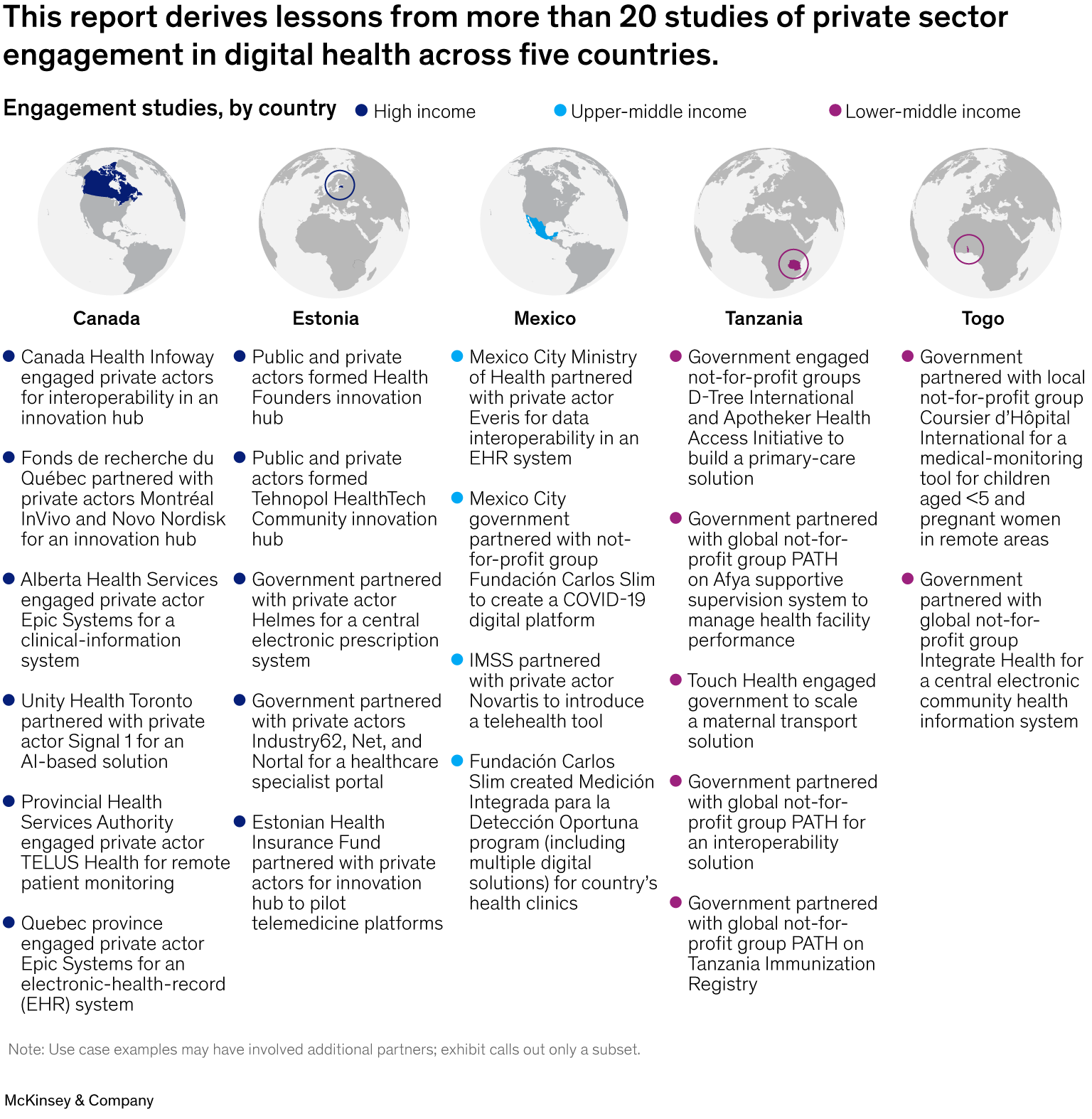
This McKinsey Health Institute (MHI) report, produced under the Digital Health Exemplars (DHE) project within the broader Exemplars in Global Health program, offers leaders a design framework to better structure public–private collaborations to realize digital health’s potential (for additional details or more on the consortium, see sidebar “About this report”). The report derives lessons from more than 20 case studies in five countries: Canada, Estonia, Mexico, Tanzania, and Togo (Exhibit 1). Through desk research, collaboration partner input, and more than 50 expert interviews, MHI distills lessons on how to design, finance, and sustain digital health partnerships with a focus on private innovation and solution providers engaging with the public sector (for more on research design, see sidebar “Methodology”). The report is divided into three sections: the digital health ecosystem, a design framework for private sector engagement, and lessons learned across countries.
Digital health ecosystem
Context affects the level of private sector activity in each country and how governments and the private sector partner in digital health. To illustrate this point, MHI compared the contexts and private sector activity across the five focus countries. Exhibit 2 shows this analysis.

As expected from the analysis, workforce and capacity, physical and digital infrastructure, and digital health ecosystem are all associated with different private sector investments.8 Canada and Estonia had more mature digital health ecosystems and greater access to digital talent, which were all associated with more private sector investment in digital health.9 Mexico, Tanzania, and Togo all had comparatively less mature digital health ecosystems and a lower share of information and communications technology (ICT) workers, which was associated with lower investment in digital health from the private sector. Notably, MHI also found that these factors associated with several aspects of public–private collaborations.
All countries, except Togo, preferred public ownership of health information exchanges (HIEs) and electronic health records (EHRs). Countries with higher digital health maturity often had public ownership of e-prescribing and telehealth systems, whereas lower maturity countries had more varied ownership of these systems. In Canada and Estonia, which have mostly public systems, the public sector has tended to be more involved in building digital health infrastructure. In contrast, in Mexico, Tanzania, and Togo, which have more mixed health systems, the responsibility for developing digital health systems was often mixed or led by the private sector.
In more mature ecosystems, case studies tended to rely on global (for example, Epic in Alberta, Canada) and local for-profit organizations (for example, Helmes in Estonia) to build and implement solutions. Emergent digital health ecosystems featured more diverse private sector actors, including foundations and funders, and global and local not-for-profit organizations, reflecting the need for the capabilities and financing of more mission-driven organizations. All case studies involved similar public sector actors, including a mix of national or federal and local governments, multinational organizations, and government-funded entities.
Design framework for private sector engagement in digital health
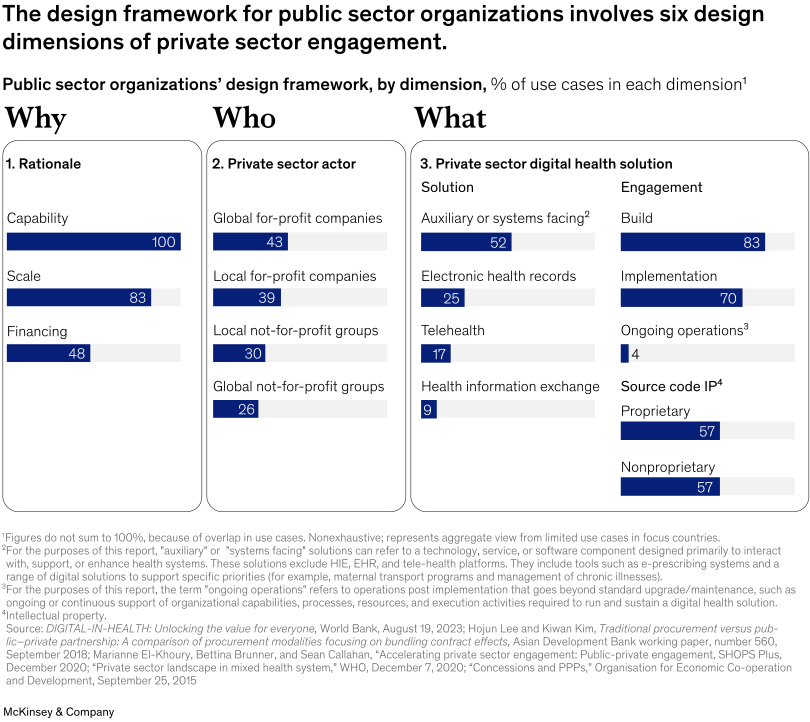
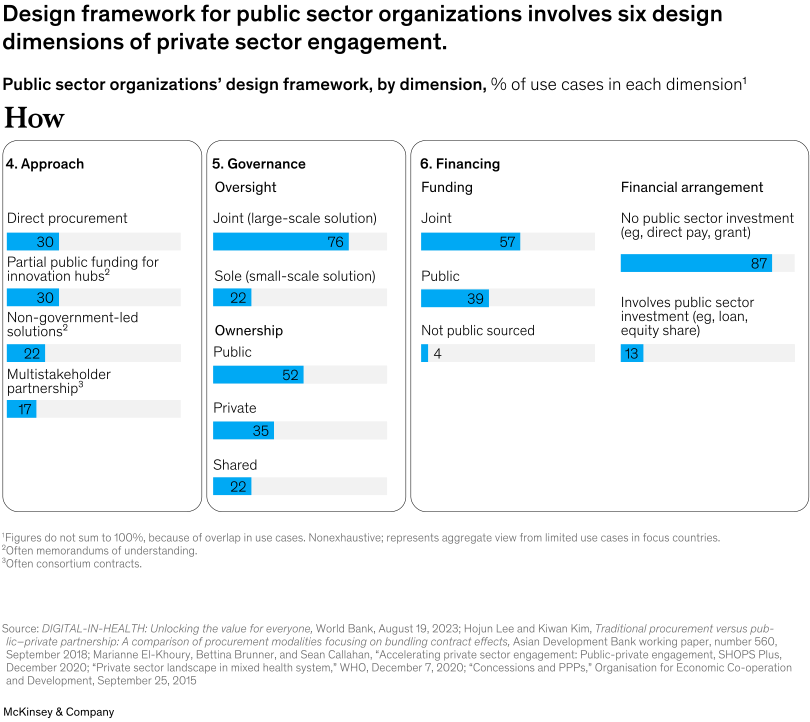
Throughout this analysis, we considered how leaders structure private sector partnerships across six design dimensions. The design dimensions framework, introduced in Exhibit 3, answers the “why, who, what, and how” of any public–private collaboration. It can help public sector actors ensure they are making design choices that reflect their context and goals. Exhibit 3 also illustrates the design dimensions and their respective applications. The rest of the section highlights observations of design choices across case studies.
Why: All case studies included multiple rationales for engaging the private sector
The public sector consistently engaged the private sector for capabilities (100 percent of case studies), such as unique technical skills. Additional reasons were the ability to scale (83 percent) in more mature ecosystems or to support financing (48 percent) in budget-constrained settings.
Who: Choosing the private sector actor
When selecting the private sector player, budget-constrained countries often collaborated with mission-driven not-for-profits (for example, the Togolese government partnered with Integrate Health), which are more likely to offer lower-cost services or financing where commercial actors may not. Less-constrained countries engaged local for-profit organizations for innovation (for example, innovation hubs such as Health Founders in Estonia or MaRS Discovery District in Toronto) and global for-profits for at-scale solutions. Countries also deployed blended solutions when partners played multiple roles (for example, the Fonds de recherche du Quebec partnered with both a local not-for-profit, Montreal InVivo, and a global for-profit, Novo Nordisk).10
What: Types of solutions
The types of solutions that focus countries engaged the private sector for were often blended solutions and products (for example, the DokitaEyes platform in Togo incorporates health records and telehealth).11 More than half of the case studies included auxiliary or systems-facing solutions (52 percent), such as facility management (for example, AfyaSS in Tanzania) or e-prescription systems (for example, Estonia). Electronic health record solutions and telehealth solutions were also common (25 and 17 percent, respectively).
How: Engagement with the private sector
The typical engagement with the private sector focused on building (83 percent) and implementing (70 percent) solutions. Relatively few engagements had the private sector to support ongoing operations solutions post-implementation beyond standard upgrades or servicing. An example exception is that the Carlos Slim Foundation and the Mexican government jointly operated the COVID360 platform after its development and implementation. Public sector actors preferred to operate solutions when directly integrating into healthcare systems or training government staff.
Proprietary and open-source code were used in similar proportions. For-profits tended to prefer proprietary code for commercial use. Countries such as Estonia promoted the use of nonproprietary code to support integration with other systems.12
The case studies had several common approaches to private sector engagement. Exhibit 4 outlines four common approaches that emerged from more than 20 case studies.
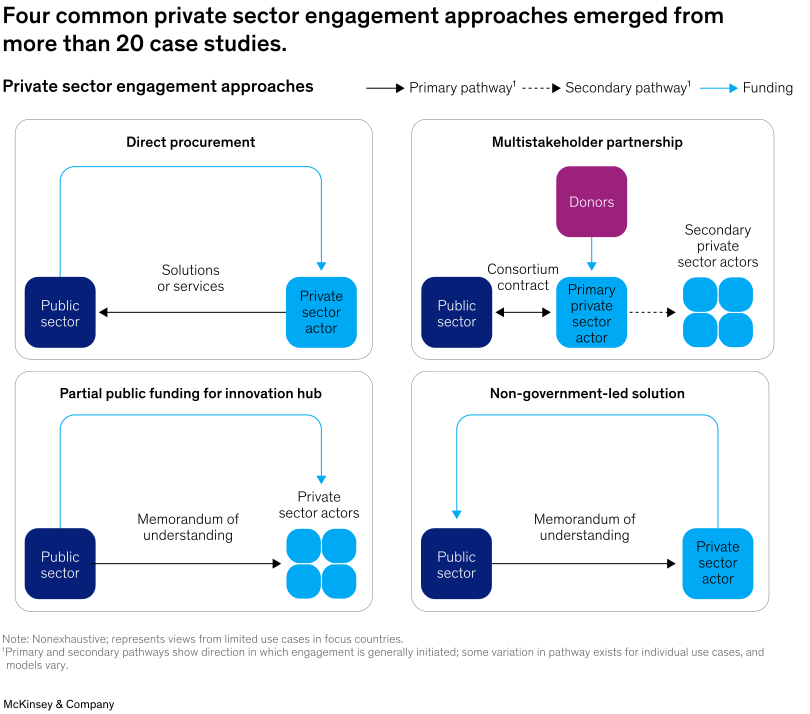
- Direct procurement, in which the public sector pays directly for digital health capabilities, was common in large-scale digital health solutions.13
- Multistakeholder partnerships were often deployed in complex stakeholder or regulatory environments and emerging ecosystems, such as those in Tanzania and Togo.14 These partnerships often employ consortium contracts, in which the public sector partners with a not-for-profit and sometimes foundations to coordinate stakeholders.
- Partially public-funded innovation hubs provide grants and resources to digital health developers.15 They often promote digital health innovation in a specific area, such as chronic diseases, and were observed in multiple countries (Canada, Estonia, and Togo) with different levels of digital health maturity.16 Innovation hub leaders may use memoranda of understanding (MoUs) to engage with hub participants.17
- Nongovernmental-driven solutions are private sector–initiated partnerships with the government designed to find and implement digital solutions. This pathway also often employs MoUs and is common in contexts with strong, local private sector actors (including established not-for-profits) and in emerging ecosystems, such as Mexico and Tanzania.18
How: Solution governance
Solution governance depends on scale and integration. Small-scale, less complex solutions often involved sole oversight. For example, Canada Health Infoway maintains full oversight of its Vendor Innovation program, which ensured alignment of solutions to the Shared Pan-Canadian Interoperability Roadmap. By contrast, larger-scale implementation tended to involve joint oversight (78 percent of case studies) between actors in the public and private sectors to spread accountability across more actors.19 Governments may favor sole public ownership (52 percent) when directly integrating solutions into public infrastructure.20 For instance, Estonia’s public sector retained ownership of the customized EHR platform that was built by three private companies. Shared or private ownership was common when the private sector played a larger role in the post-implementation process.
How: Financing partnerships
To finance partnerships, most case studies used joint funding (57 percent), in which the public and private sectors shared some costs. Mature digital health ecosystems may rely on direct public funding, supported by tax revenues and health insurance systems, as seen in Canada, where Infoway directly funds local digital health companies with demonstrated impact to scale their solutions. Countries with nascent ecosystems were more likely to require donor assistance or private sector financing. For instance, in Mexico, Novartis, a global for-profit company, funded the development of a telehealth and prescription platform, which allowed patients to access care and medication more quickly. Most case studies used direct payments or grants, but in some models in Canada and Estonia, the public sector structured its contribution as an equity stake to create a longer-term partnership with aligned incentives.21
Lessons learned
Governments that engaged the private sector overcame five common challenges: not knowing where to invest, challenges in finding the right capabilities, overcoming financial uncertainty, historic mistrust of the private sector in healthcare, and uncertain long-term sustainability. These challenges include common market failings observed across countries and beyond digital health, as well as concerns related to data privacy, cost sustainability, and equitable access. Below, MHI distills these challenges and the spectrum of solutions used to address them into five lessons.
1. Guiding stakeholders on where to invest or build solutions
Private sector actors often lack clarity on where to invest in digital health. The public sector can guide them. Across our five focus countries, MHI observed a spectrum of approaches that signal to private sector actors where to invest and how to integrate solutions into existing infrastructure. Countries such as Tanzania have developed a national digital health road map outlining the capabilities, scale, and finance required from the private sector to guide investment toward national priorities. Other countries, such as Estonia, have established common standards of interoperability aligned across government and private actors, allowing investments to build on existing infrastructure and drive greater impact. Governments sometimes provided guidance down to the use case. In Canada, Infoway’s Vendor Innovation Program focused on projects designed to address key bottlenecks in health data exchange, care coordination, and improved patient outcomes.
2. Effectively engaging private sector actors
The public sector may be seeking guidance for how and where to apply private sector capabilities. Effective engagement with trusted actors can build awareness, improve solution quality, and streamline operations.22 For example, the Carlos Slim Foundation partnered with the Mexican government to scale MIDO, a mobile health program designed to improve treatment for chronic diseases in more rural areas, across the entire country. The government engaged the foundation for their preexisting proven solution and technical capabilities, while the foundation benefited from the public sector’s reach. MIDO rolled out nationally in 2012. It has reached approximately 3 million patients and reduced stockouts in clinics that implemented the platform by as much as 15 percent.23 Establishing transparent procurement processes and centralized technology-enabled platforms can further improve engagement with the private sector, streamline operations, and maintain high standards of performance. The CAN Health Network in Canada, for instance, operates a coordinated vendor platform to streamline procurement (as does the Provincial Health Services Authority in British Columbia).
3. Offering an ecosystem of incentives to boost private sector engagement
Financial uncertainty often discourages private sector participation in new markets and segments. A full ecosystem of incentives and even new mechanisms can boost private sector participation in resource-constrained conditions. A broad range of tools, such as tax breaks and grants, can be used to attract private sector investment.
For example, Togo introduced an innovation tax framework in 2023, providing incentives for start-ups that invest in private infrastructure and healthcare to direct innovation toward national health priorities.24 The analysis also found that the public sector used new tools such as innovation hubs to rapidly develop new technologies and improve global competitiveness. The publicly funded Health Founders Estonia innovation hub bridges critical capability gaps that early-stage start-ups often face by providing dedicated mentorship, technical and regulatory support, a structured development program, community hubs, and living labs for product testing. While companies retain ownership, Health Founders connects them with investors and may take small equity stakes in international ventures to align incentives and support scaling. Countries can further improve the private sector’s ability to safely access data, as seen in Finland, to encourage research and support the development of their innovation ecosystem.25
4. Establishing data privacy guardrails
Historic mistrust and concerns over data privacy violations and data breaches can hinder collaboration. Data privacy regulations can derisk private sector activity for all stakeholders.
Enforcing balanced data privacy regulations and requiring oversight for accessing sensitive data may build trust among the public sector and patients over time and mitigate operational and reputational risks from violations and breaches. For instance, the Estonian government enforces the General Data Protection Regulation and the Estonian Personal Data Protection Act for all private sector actors.26 Enforcement and oversight give confidence to end users (for example, hospitals and patients) that their data is safeguarded and assure other private sector actors that they are operating on a level playing field. Countries often must consider how to find the right balance to support innovation and the safeguarding of information through regulations.
5. Providing for the sustainability of digital health solutions
Private sector actors may be reluctant to engage when a program’s sustainability is uncertain. Planning long-term financing and ownership at the outset can build confidence for an investment.
Governments can accelerate progress toward national health priorities by engaging nonpublic sector financing or funding partners to pilot or scale health programs. For example, in Tanzania, the Vodafone Foundation, collaborating with the government and Touch Health, initially financed a national system for emergency transportation for women and newborns known as m-mama.27 Touch Health built and scaled the solution and transitioned ownership to the Tanzanian government, which integrated m-mama into the country’s ICT system.
Governments can also implement innovative financial structures, such as deferred payments, or take equity stakes in private digital health companies to sustain longer-term partnerships.28 For instance, the Unity Health hospital system in Toronto licensed several of its technologies to Signal 1 and made a small equity investment in the company.29 In exchange, Signal 1 is scaling those technologies and will use the Unity Health hospital system as a “living lab” to test future innovation. The collaboration has already launched and scaled CHARTWatch, an AI-based monitoring system designed to address patient needs.30 To build public sector capabilities over time, governments have also established phased ownership transition periods (for example, m-mama in Tanzania) and allowed real-world testing of digital health solutions. In Canada, solutions developed through the Unity Health Toronto and Signal 1 partnership can be tested within Unity’s hospital network.31
For a deeper exploration of approaches to overcome challenges, refer to the “Lessons and examples” table.
Lessons and examples
| 1. Guiding stakeholders on where to invest | |
| Lessons learned | Examples |
| Developing a digital health solution road map can create a shared understanding of vision and technical requirements and clarify standards. | The Tanzanian government, in collaboration with PATH and with funding from the Bill & Melinda Gates Foundation, developed its Digital Health Investment Roadmap.1 Under the guidance of this plan, the government engaged PATH to develop a Health Information Mediator platform to support health system interoperability.2 |
| Defining solution ownership can improve alignment and administration. | In Canada, the Alberta Health Services (AHS) contracted Epic to jointly oversee the creation of an interoperable EHR system, Connect Care.3 Since its completion in 2024, the AHS now fully owns and administers the system. |
| 2. Effectively engaging private sector actors | |
| Lessons learned | Examples |
| Partnering with trusted private sector actors (including not-for-profits and foundations) with specialized knowledge and resources may improve solution quality and adoption. | The Tanzanian government collaborated with D-tree and the Apotheker Health Access Initiative (AHAI) to develop and scale a digital primary care solution connecting community health workers, health facilities, and drug dispensing outlets. The solution, Afya-tek, helps address fragmentation and reliance on paper-based reporting in Tanzanian healthcare. The government chose digital health organization D-tree and AHAI for their pharmaceutical expertise, experience scaling digital health solutions, and access to funding. During Mexico’s COVID-19 response, the Government of Mexico City partnered with Carlos Slim Foundation (CSF) to establish a fully functional COVID360 platform to treat over 9000 COVID patients. The hospital platform was primarily funded by the foundation with a small portion funded by public actors.4 |
| Establishing transparent procurement processes, inclusive of diverse suppliers, and including adequate technical evaluation criteria can streamline processes and improve solution quality. | The Estonian government offers transparent guidelines to ensure effective procurement, including detailed technical specifications in requests for proposals, leading to higher-quality outcomes.5 |
| Implementing centralized, technology-powered platforms can streamline procurement processes. | The CAN Health Network in Canada has developed a network of providers and vendors to expedite procurement for vendors that have already implemented similar solutions with other network members. |
| 3. Full ecosystem of incentives to boost private sector engagement | |
| Lessons learned | Examples |
| Creating financial incentives (eg, tax breaks, grants) and using those to target specific capabilities can encourage investment in priority areas. | In January 2025, tax incentives were announced in Mexico to support private infrastructure and health investments in rural areas.6 |
| Investing in innovation hubs can encourage targeted innovations and improve the global competitiveness of private sector solutions. | Health Founders in Estonia supports private commercialization efforts in international markets by providing resources on certifications and legal guidance. |
| Centralizing and securing health data can encourage and facilitate research. | The Estonian government partnered with Helmes to develop the systems-facing e-Prescription solution, which has been integrated with the core infrastructure (ie, the national Estonian Education Information System) to centrally share and store digital prescription records.7 |
| 4. Data privacy guardrails | |
| Lessons learned | Examples |
| Enforcing data privacy regulations may build trust among all stakeholders (including patients using services) and encourage collaboration. | Estonia enforces the General Data Protection Regulation8 and the Estonian Personal Data Protection Act9 (PDPA) for all entities, including digital health private sector actors participating in public procurement. |
| Incorporating oversight as a requirement for accessing sensitive, centralized data may provide incentives for compliance and build trust. | The Finnish Biobank Cooperative – FINBB requires private sector actors using biobank data to adhere to strict privacy and data usage agreements. |
| 5. Sustainability of digital health solutions | |
| Lessons learned | Examples |
| Accessing non–public sector financing can catalyze national health priorities. | In Togo, the Fonds de Solidarité pour les Projets Innovants funded the ISME-Togo project, which improves health access for pregnant women and children under the age of five. This work is critical in Togo, where maternal and newborn diseases have the third-largest gap for care and delivery efficiency in the country. |
| Implementing innovative financial structures (eg, deferred payment arrangements, equity stakes, fee-based models) may smooth cash flow and ensure accountability. | Canadian hospital Unity Health Toronto and Estonia’s Tehnopol HealthTech Community have taken minor equity stakes in digital health for-profits, aligning interests and offering potential ROI. The Mexican Institute of Social Security partnered with Novartis to build a consultation and prescription platform. Novartis financed the initiative under the arrangement that it received payment for medicines bought through the platform.10 |
| Establishing phased ownership transition periods (eg, private to joint, joint to public) can enable knowledge transfer and build public capabilities. | In Tanzania, private actors such as Touch Health support the public sector technically and financially while gradually transferring solution ownership.11 The Togolese government and Integrate Health jointly oversaw the building of a community-based health information system, eventually transitioning ownership to the government post-deployment.12 |
| Testing solutions in public health systems can build capabilities and improve technical sustainability. | Canadian innovation hubs (eg, Unity Health Toronto) enable digital health solution developers to test and scale their solutions within healthcare providers.13 Developers improve their skills and ensure solutions work in real healthcare settings. |
The daily challenges of health systems are familiar, from crowded waiting rooms and overworked nurses to paper records that cannot always match fast-moving outbreaks or meet demand. Digital health cannot solve every problem, but when integrated effectively with broader health system reforms, it can help reduce administrative burdens for healthcare professionals, making queues shorter, records more accurate, and healthcare more consistent, especially for those living farther away from hospitals or health centers.
The private sector offers solutions that patients and caregivers can often feel immediately: extra capacity, sharper last-mile logistics, and user-focused innovations. Faster product cycles, agile processes, and fresh capital ensure continuous improvement and adaptation, particularly to incorporate the latest advancements in AI-driven digital health technology. However, none of those benefits replaces public stewardship. Private sector engagement works best when the public sector creates conditions for trust, sustainability, and security for all parties.
This report provides a perspective for creating those conditions. It offers perspectives on why to partner and how, models that have worked in comparable settings, and tools—procurement paths, governance checklists, and outcome measures—to shape partnerships. This report shows there is not one single blueprint. What matters is starting from the realities of each health system and then shaping partnerships that are practical, trusted, and sustainable.
For additional digital health exemplars research, visit the Digital Health Research Roundup website for the Center for Global Digital Health Innovation at the Johns Hopkins Bloomberg School of Public Health. See here for more information on the Exemplars in Global Health’s digital health research.
Related Articles

Building interoperable healthcare systems: One size doesn’t fit all