There has been meaningful momentum toward the energy transition, but a number of forces are creating uncertainty. They include shifting geopolitics, policy uncertainty in many countries, the macroeconomic environment, and rising energy demand from the adoption of artificial intelligence tools, to name a few.
But even in the face of these near-term uncertainties, it is important not to lose sight of the core—long-term—challenge at the heart of the transition. The energy transition is a physical transformation on a massive scale. Billions of parts associated with today’s highly complex, interconnected, and optimized system of energy production and consumption would need to be transformed—substituting high-emissions technologies that rely on fossil fuels with a new generation of low-emissions options—with an aspiration to do so in just decades. This will require tackling, as our 2024 report put it, the “hard stuff”—grappling with the physical challenges associated with the development and deployment of high-performing low-emissions technologies and the associated infrastructure and supply chains they need in order to operate.1
We are already seeing the physical nature of the transition manifest. On the one hand, global physical deployment of clean technologies such as renewables and electric vehicles has continued to accelerate. Installed renewable capacity (led by record deployments of solar power) is estimated to have increased by more than 10 percent from 2023 to 2024, and passenger electric vehicle sales—both battery-powered (BEVs) and plug-in hybrids (PHEVs)—by more than 25 percent from 2023 to 2024.2 And technologies continue to improve, including, for instance, longer-ranging EVs, new stationary storage technologies, and air-source heat pumps that can provide uninterrupted heat at temperatures below minus 20°C.3
Nevertheless, it is increasingly evident that more needs to be done to deal with physical challenges head on. For example, as power systems accommodate a higher share of renewables like solar and wind that are, by their nature, variable, there is growing recognition of the need to manage volatility.4 Rising energy demand from data centers has also demonstrated the challenge with scaling up power capacity. In the United States, interconnection projects typically take nearly five years from the interconnection request to commercial operation, and an estimated 70 percent of transmission lines are more than 25 years old and would need to be replaced within ten to 20 years.5
Overall, more will need to be done to deal with the physical challenges associated with the large scale-up of low-emissions technologies. So what are those challenges and how should stakeholders navigate them? To support decision-making, our analysis published in 2024 is what we believe is the first comprehensive stock take of those physical challenges.6
In this article, we draw on that research to highlight ten key insights that are relevant to the core components of the transition—to the power sector, which is at the heart of the transition; to the three major end-use sectors, namely mobility (road vehicles and other forms of transportation to move people and things), industry (which manufactures a broad range of materials and goods like steel and cement), and buildings (facilities that consume energy for lighting, heating, and more); and, finally, to the three enablers of the energy-system transformation, namely raw materials (particularly the critical minerals needed for many low-emissions technologies like batteries and electrolyzers), new energy carriers (such as hydrogen and biofuels), and carbon capture and energy reduction approaches to manage any remaining emissions.
Tackling the energy transition would entail a complex physical transformation
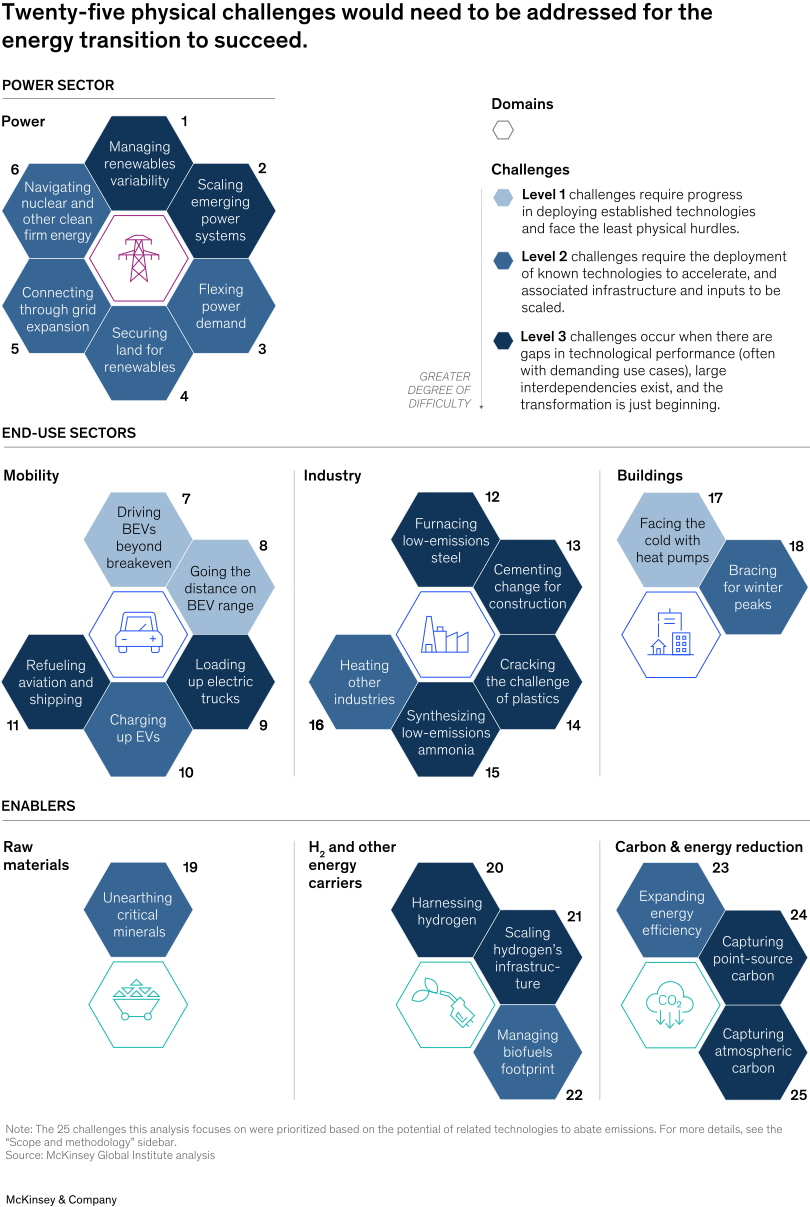
This article highlights ten physical realities of the energy transition. They are part of a highly complex physical transformation that would need to be undertaken to deliver success. In our August 2024 report, we identified 25 physical challenges across the energy system that would need to be overcome for the transition to succeed (Exhibit 11).
Some of the 25 are harder to address than others. We categorized the 25 physical challenges into three levels of difficulty based on technological performance gaps, interdependencies with different challenges, and scaling needs. Nearly half—12 of the 25—are what we describe as Level 3 challenges. These are challenges that are particularly hard to tackle. Yet abating about half of energy-related CO2 emissions depends on addressing them.
To explore all 25 challenges and what it would take to tackle them, see our full report.
Related Articles

