Chances are that every European consumer industry executive has had some version of the same conversation this year. Boards want to understand where AI investments are going. CFOs want to see measurable returns. Strategy teams point to an expanding set of AI initiatives across marketing, customer experience, supply chain, and technology development. Yet when pressed on bottom-line impact, many organizations still give the same answer: It is too early to tell.
This is the paradox now emerging across the European consumer sector. Companies are investing more in artificial intelligence than ever before and expanding AI across a wide range of business domains—yet measurable financial impact remains limited. Ambition is accelerating faster than execution capability, and the gap between the two may be the defining challenge for consumer industry leaders in the year ahead.
Between December 2025 and January 2026, McKinsey circulated an in-depth questionnaire to 27 C-suite executives across the European consumer industry—spanning retail, consumer packaged goods, apparel and fashion, and related consumer services—to learn more about their AI strategies; investment priorities; organizational readiness across talent, data, and technology; and their progress toward scaling AI. More than half of those we queried hold chief information officer or chief technology officer roles, and nearly a quarter serve as chief data officers or chief data and analytics officers. The group skews toward large enterprises (16 of 27 employ more than 20,000 people). While the sample is small and not necessarily representative of the industry as a whole, the perspectives and insights shared by these key decision-makers offer a directional view into how the industry is progressing with AI and where it continues to struggle.
Ambition is rising—but so is the gap to execution
Our informal survey reveals a striking contrast: 23 out of 27 of the executives report that their organizations increased AI activity over the past year, and not one reports scaling back. Yet only six respondents report EBIT impact of 1 percent or more from AI initiatives, and more than half say it is still too early to determine financial impact at all.
This ambition–execution gap may be the defining characteristic of the European consumer industry’s AI journey today. Companies are experimenting broadly across the value chain, but many have not yet built the capabilities required to translate experimentation into scalable business impact.
Bold aspirations, growing budgets
If our questionnaire reveals any shortage, it is not one of aspiration. The executives we queried increasingly see AI as central to their future competitiveness. More than half describe their three-year AI ambition as either “significant” or “transformative” change. Investment expectations reflect this ambition. Twenty-two of our 27 respondents plan to increase AI spending over the next year. Most anticipate increases between 10 and 30 percent; five expect spending to rise by more than 30 percent. Current investment levels are already material: More than half of respondents report allocating at least 5 percent of their digital budgets to AI initiatives, and more than a third allocate between 10 and 30 percent.
AI activity spans a broad set of domains across the consumer value chain (Exhibit 1). Marketing and growth functions are the most common focus areas, cited by 19 respondents. Software development and technology operations follow closely (18 and 17 respondents, respectively), reflecting the growing use of AI in engineering productivity and automation. Demand forecasting, customer experience, pricing and promotion, supply chain operations, and product development also appear frequently across the AI portfolio.
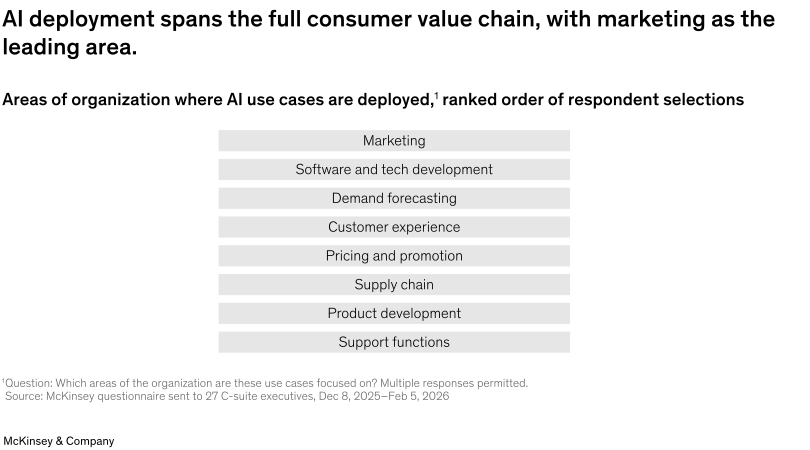
Organizations, in short, are not placing single or simple bets on AI. They are deploying it broadly across multiple parts of the enterprise.
Yet while activity is expanding, strategic alignment often remains incomplete. When asked about the maturity of their AI strategy, ten of the 27 executives describe it as “developing,” meaning that strategies exist in parts of the organization but are not yet integrated enterprise-wide. An equal share reports that their strategy remains “emerging,” with early discussions or initial plans underway. Only a small minority reports an established strategy with clearly defined value targets and a prioritized road map.
This suggests that many organizations are expanding AI initiatives faster than they are building a coherent enterprise strategy to guide them—a pattern that may help explain why financial impact has been slow to materialize.
The capability foundations are not yet in place
Ambition alone does not deliver results; execution capability determines whether AI investments translate into real impact. Responses to our questionnaire suggest that many consumer companies face meaningful capability gaps across several foundational dimensions: talent, literacy, data, and technology.
Talent emerges as the most significant constraint. Only nine respondents say their organizations have the right people in place to develop and scale AI effectively. This is consistent with our own experience serving clients: For many organizations, the challenge is not replacing workers but assembling the right combination of data scientists, machine learning engineers, product managers, and domain experts who can work together to deliver business outcomes.
AI literacy across the broader workforce has not kept pace with investment, either. Nearly two-thirds of respondents describe their organization’s AI literacy as developing, indicating that structured training programs exist but adoption remains uneven across functions. Only two report widespread, day-to-day use of AI across the organization. This gap highlights an important asymmetry: Although companies are expanding AI initiatives, relatively few have achieved the broad workforce adoption needed for AI to reshape how work gets done.
Data infrastructure and technology platforms remain another major constraint. Three-quarters of respondents rate their data infrastructure below the established level of maturity. Technology infrastructure shows a similar pattern, with only one respondent reporting systems robust enough to support enterprise-scale AI deployment.
One encouraging signal emerges around collaboration between business and technology teams. Nearly half of respondents report strong alignment between these two groups, although a quarter still report significant misalignment. Given that AI applications span multiple domains, from marketing to supply chain, this cross-functional collaboration will be essential to translating AI investments into business outcomes. The organizations that close this alignment gap fastest are likely to see results sooner.
Broad pipelines, shallow deployment
Despite rising ambition, deployment outcomes remain uneven, suggesting that many organizations are caught in what might be called a “pilot trap.” Many of the leaders we reached out to have built sizable pipelines of AI initiatives. Eight said they manage portfolios of ten to 20 projects; six report more than 50. On average, however, only about 10 percent of our respondents’ AI initiatives have reached scaled deployment. Many remain in proof-of-concept or development stages, and more than a third have not even started. The result is a broad but shallow deployment pipeline, with wide-ranging experimentation that has not yet converted into enterprise-scale impact.
Financial outcomes reflect this pattern. More than half of respondents report that it is still too early to determine whether AI has had a measurable impact on EBIT. Among the nine respondents who report impact, only two cite substantial financial gains (5 to 10 percent EBIT improvement). Where value has emerged (Exhibit 2), it is most often associated with operational efficiency: cost reduction was the most commonly cited benefit, followed by improvements in customer satisfaction and innovation.
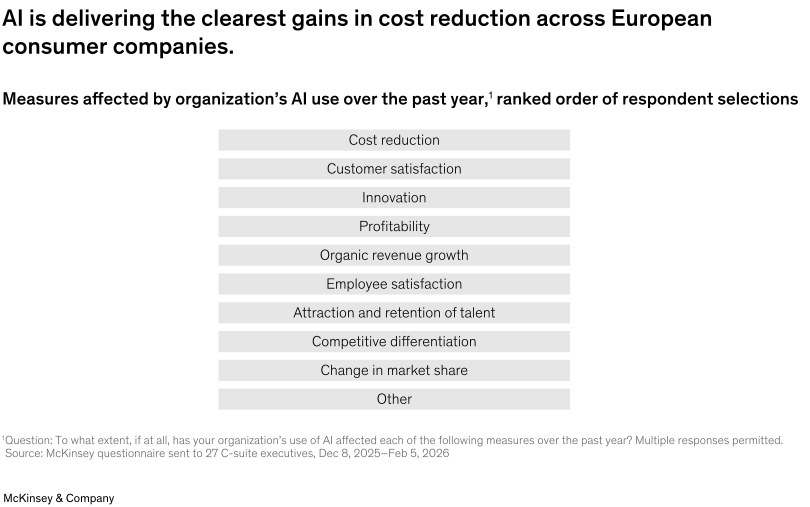
AI in the European consumer industry is, at this stage, delivering more value through efficiency gains than through transformational revenue impact. The question is whether leaders are deliberately sequencing their efforts toward higher-value outcomes or simply drifting toward the path of least resistance.
The next frontier: Agentic AI and an expanding risk landscape
Even as many organizations work to scale current AI applications, the next wave of AI technology is already entering strategic discussions. Agentic AI—systems capable of autonomously executing multistep tasks—is beginning to attract attention across the consumer industry. Most organizations, however, remain in the early stages of exploring these capabilities. Roughly three-quarters of the leaders we queried report that their progress toward agentic AI remains at the emerging or developing maturity levels.
The implications are significant. Agentic systems will require stronger foundations in data quality, system integration, governance, and infrastructure than current AI tools demand. Organizations that have not yet addressed these foundational capabilities for conventional AI may find it substantially more difficult to adopt more advanced AI systems as they mature. The gap between leaders and laggards could widen considerably.
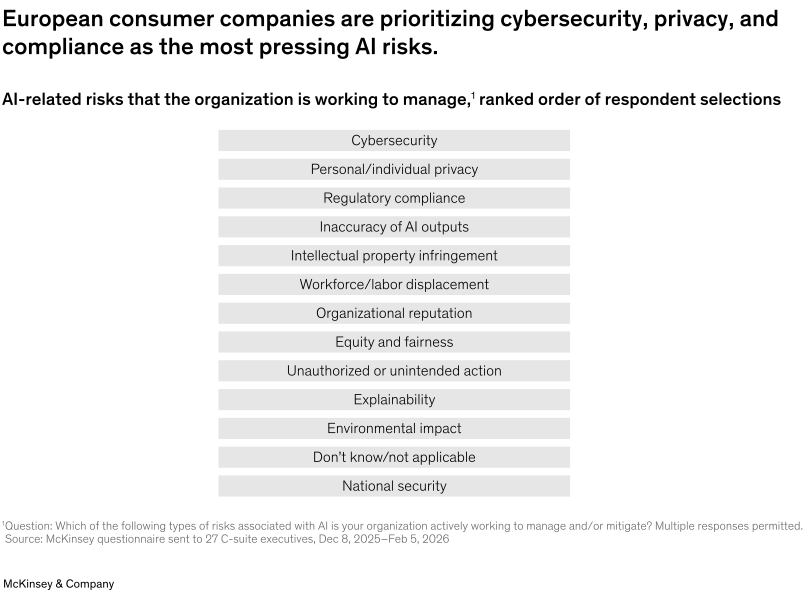
At the same time, the risk landscape is expanding. Respondents to our questionnaire report actively managing risks (Exhibit 3) related to cybersecurity, data privacy, regulatory compliance, and output accuracy. Workforce displacement, reputational risks, and fairness concerns also appear on leadership agendas. So far, relatively few respondents report experiencing significant negative incidents from AI deployments—a finding that likely reflects both early-stage adoption and the governance frameworks already being implemented.
Regulation will further shape how AI evolves in the European market. The EU AI Act, which will take effect in phases through 2026, introduces new requirements around transparency, risk classification, and governance for AI systems. For consumer companies operating in highly customer-facing environments, these regulations will influence how AI can be deployed across domains such as personalization, pricing, and workforce management. Leaders who treat compliance as an opportunity to build trust—rather than merely a cost of doing business—may find themselves better positioned as the regulatory landscape stabilizes.
From ambition to impact: What it takes to scale AI
What steps should business and technology leaders take to break free from the AI paradox and realize genuine, measurable value from their AI initiatives? McKinsey’s Rewired playbook for AI transformation provides a clear pathway provides a clear pathway.
Start from business value and concentrate investment on the few bets that matter most
Many organizations are spreading AI investments across a wide range of initiatives. Leading organizations take a different approach: they define a clear strategy, identify the highest-value use cases, and concentrate investment accordingly. Rather than distributing resources evenly, they prioritize a small number of big bets where AI can propel measurable performance improvement while reserving a smaller share of investment for experimentation and future opportunities, often following an 80/20 split between scaling proven use cases and exploring the next horizon.
Move fast with ‘good enough’ data and technology
Data and technology remain important enablers, but perfection is often the enemy of progress. Many organizations still face gaps in data and technology maturity. Rather than waiting to resolve these fully, leading organizations focus on making data and technology sufficient to support priority use cases, allowing them to deploy, learn, and iterate quickly. Speed of execution, not technical perfection, is what enables progress from pilot to scale.
Treat AI as a holistic business transformation, not a technology program
Scaling challenges are not only technical. AI literacy and adoption remain uneven across organizations, pointing to a broader operating model challenge: embedding AI into how work gets done. Organizations that succeed invest in new ways of working—embedding AI talent in business teams, upskilling the broader workforce, and aligning incentives and ownership with business outcomes. AI becomes part of the operating model, not a parallel technology effort.
Sequence the journey and invest in adoption at scale
Scaling AI is not a one-step transformation. Many organizations have built broad pipelines of initiatives, but relatively few have reached scaled deployment. Organizations that generate impact take a staged approach: proving value in targeted domains, scaling what works, and building capabilities over time. This requires sustained investment in adoption—training, change management, and leadership alignment—often exceeding the effort spent on technology itself.
From experimentation to execution
The European consumer industry has crossed a threshold. AI is no longer a peripheral experiment; it is a strategic priority for most large organizations. Budgets are growing, ambitions are expanding, and the range of AI applications across the value chain is broader than ever.
Yet responses from consumer industry leaders we queried make clear that investment and activity alone do not produce impact. The organizations that will lead in the next phase of AI adoption will not necessarily be those that launch the most initiatives. They will be those that build the foundations—talent, data, technology, and governance—to scale the initiatives that matter most.
The AI paradox does not have to be permanent. But resolving it will require a shift in emphasis: from breadth of experimentation to depth of execution, from counting initiatives to measuring outcomes, and from ambitious strategies to the disciplined, unglamorous work of building the capabilities that make AI deliver at scale.




The authors wish to thank Astrid Oleander, Joe Boden, and Kari Ringi for their contributions to this article.
This article was edited by Larry Kanter, a senior editor in the New York office.
This article contributes to McKinsey’s ongoing research on AI and aims to help business leaders understand the forces transforming the consumer industry, identify strategic impact areas, and prepare for the next wave of growth.
Related Articles