The technology story of 2026 has moved off the screen and into the physical world. Innovation is accelerating in the power grids and chips that underpin the data center boom; in the intelligent robots that embody AI; in the agentic systems discovering new chemical compounds; and in the launch pads sending thousands of satellites into orbit.
AI needs energy to scale. That’s one reason energy technologies alone drew nearly $200 billion in investment in 2025, among the highest capital influx in any technology domain. And spending on AI infrastructure doubled in a single year. These developments show that the defining questions today are not only about what technology can do. They are also about who can build the hardware and assemble the skilled workforce to deploy AI in the real world. At the same time, huge leaps were made in cybersecurity and software development—illustrating that AI is accelerating the digital frontier, too.
McKinsey’s Technology Trends Outlook 2026 examines 14 technology trends that define 2026, expanding our coverage from last year to include two new fast-emerging domains: agentic software development and AI for scientific discovery and engineering. For easier navigation, we group the trends into three broader categories: AI revolution, compute and connectivity frontiers, and cutting-edge engineering. The lines between these domains are blurring, and much of the innovation is happening in the gaps.
The report is based on extensive quantitative analysis. We measured metrics on innovation, investment, interest, talent demand, and organizational adoption (see sidebar “Research methodology”). It also draws on qualitative interviews with business leaders, policymakers, investors, and experts across sectors and geographies. The technologies included in this report were selected based on their rate of innovation, as well as their growing applicability and potential to influence how we live and work (see sidebar “How we chose the trends”).
Four of this year’s trends are AI specific, but AI also underpins and amplifies the other ten. AI has become an accelerant in robotics, creating a new class of autonomous bots capable of interacting with the world around them. AI is reshaping software development, making coders many magnitudes more productive. AI is advancing scientific discovery, helping life sciences companies discover new drugs many times faster than before. And AI is optimizing the foundations of technology infrastructure itself, changing cybersecurity operations, and catalyzing new innovations in semiconductors. These are just a few of the ways AI is shifting the sands beneath our feet.
Beyond the AI ecosystem, many of this year’s trends are being shaped by large-scale economic, geopolitical, and workforce transitions. Scientists and engineers are discovering new possibilities in therapeutics, diagnostics, genomics, and brain science. Robotics, mobility, and immersive-reality technologies are converging to reshape how humans interact with digital and physical systems. Sustainability technologies are transforming how energy is produced, managed, and used—providing potential solutions to meet surging power demand from data centers. And quantum computing continues to advance, giving a glimpse into how it could soon solve problems that would otherwise be infeasible.
This breakneck pace of change comes with challenges. Organizations are racing to deploy AI at scale without any proven road maps. They have workforces that need upskilling, legacy systems that need updating, and networks exposed to ever-evolving security risks. They face shortages in energy, talent, and capital. Overcoming these roadblocks requires far more than just deploying technology. It requires rewiring operational models from the inside out.
New and notable
With so much happening across so many technologies, it’s not easy to identify what matters most. But across all 14 trends, five themes kept surfacing—ones we think all leaders need to understand to steer their organizations into the future.
Machines are being given more autonomy
AI has already transformed screen-based workflows—generating answers, drafting documents, and summarizing calls—and is rapidly advancing into an agentic era, in which it will complete many end-to-end digital tasks on its own. Agentic AI is becoming the connective tissue of the enterprise, with agents working alongside humans, changing not just tools but operating models. Physical AI is the next frontier. Making the jump to the real world, AI is adding perception, reasoning, and action across robotics, mobility, and wearables. General-purpose robots are being trained to learn about their environments so they can execute complex tasks and navigate unpredictable environments. Vehicles can make real-time decisions without drivers. Industrial systems can produce complex goods inside “dark factories” with no humans present. And immersive-reality headsets are interacting in real time with both wearers and the outside world. Physical AI is arriving first in manufacturing and logistics, where the economics are clearest. But the trajectory points well beyond the factory floor, toward hospitals, construction sites, farms, and city infrastructure.
AI is generating breakthroughs faster than we can absorb them
In biopharma, AI can now propose thousands of drug candidates in the time it once took to generate a handful. But it can’t compress the years of wet-lab validation, clinical trials, and regulatory review that follow. In software, AI is producing code faster than human systems can review, test, and deploy it securely, filling enterprise systems with brittle code. In materials science, promising compounds are arriving faster than labs can synthesize and validate them. AI is the most powerful accelerant in recent history. Its speed is also its biggest obstacle.
The cyber defense window has compressed
For decades, the cat-and-mouse game of cybersecurity played out over days and weeks, giving defenders time to find and fix vulnerabilities before attackers could fully exploit them. AI has eliminated that buffer. More than three-quarters of all cybersecurity vulnerabilities are currently classified as “zero day,” meaning that by the time they are publicly disclosed, an exploit has already been developed.1 Thus, while AI is helping security teams find and fix vulnerabilities faster, it is also helping attackers find and exploit them faster. Anthropic’s handling of Claude Mythos Preview reflects this duality. The model identified thousands of potential security flaws. So rather than release the model publicly, Anthropic gave a limited group of defenders gated access through Project Glasswing to identify, validate, and patch the vulnerabilities.2
Hardware and software are being codesigned for differentiated AI workloads
General-purpose chips have long powered everything from laptops to data centers. AI changed that. Training models and then running them at scale (what’s known as inference) demands something more specialized: chips optimized for specific workloads. Inference is overtaking training as the dominant AI workload. As model architectures continue to evolve, new application-specific chips are being designed to deliver inference on those models more efficiently, providing more output per watt at a lower cost. This is critical, as data centers’ energy demand is increasingly straining power grids. Hyperscalers are investing heavily to build data centers and have much to gain from faster, higher-performance chips. Thus, Amazon, Google, Meta, and Microsoft are increasingly partnering with semiconductor firms to codesign custom silicon tailored to their AI models—and some are exploring ways to offer these chips to outside customers as competitive products. (In the chip industry, the customer is becoming an alternative supplier.) But these new-format chips are not just affecting the semiconductor sector. They are changing how physical AI infrastructure is designed and transforming the business models of the equipment makers and energy suppliers that support these build-outs.
AI is hungry, and the grid is not ready
The race to deploy AI at scale has run headlong into a constraint that hyperscaler ingenuity cannot entirely solve: power. US data centers running AI workloads alone are projected to consume as much electricity by 2030 as California does today.3 Globally, the numbers are even larger. The problem is not just how much power AI needs but how hard it is to deliver. Data centers can be built faster than the transmission lines, substations, and transformers needed to power them can be supplied. Supply chain constraints are often to blame. In many markets, transformers now carry lead times of more than two years. More than 2,500 gigawatts of energy projects are stalled in grid queues worldwide, waiting for connections that may be years away.4 For enterprises, securing reliable compute power is becoming as much a competitive advantage as securing talent or capital.
When measuring talent demand, we see signals that some trends are maturing and selectively scaling. In connectivity, cybersecurity, energy, life sciences, and mobility, more than half of job listings were for non-R&D roles such as general and administrative, operations, and sales and marketing. While these trends are still driven by innovation, deployment is underway. Companies are now applying these technologies in use cases with commercial viability. Meanwhile, in all four AI-related trends plus application-specific semiconductors, over 75 percent of jobs posted were in the R&D category, illustrating just how early these sectors are, despite rapid growth in the past few years.
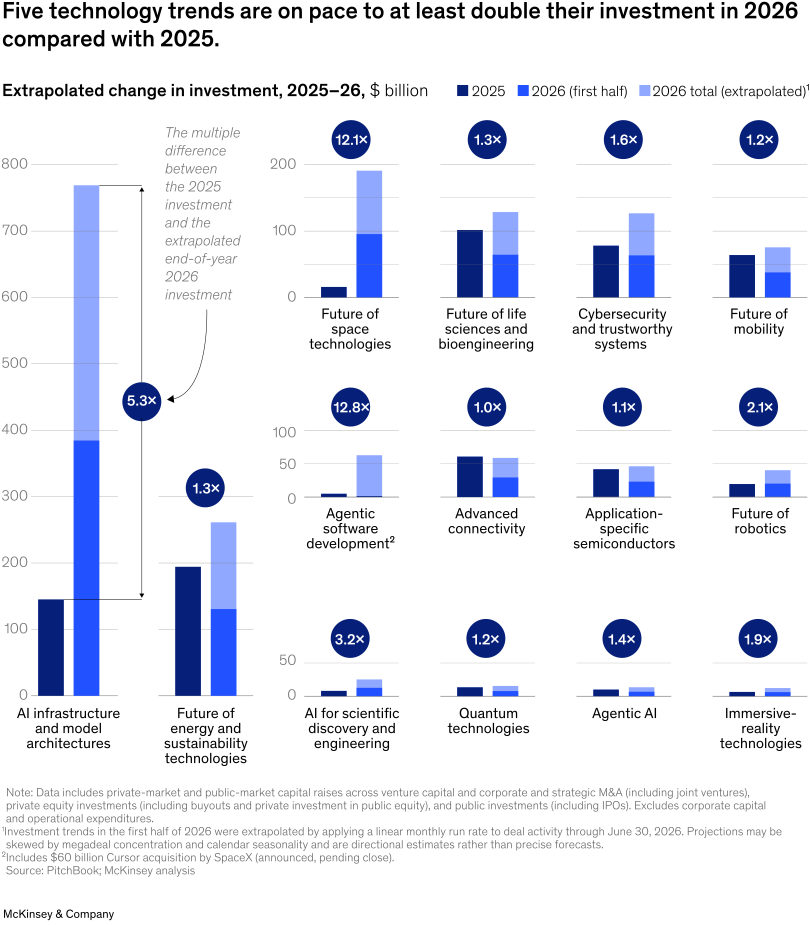
Investment metrics provide insight into the technology trends that have captured the most conviction, yet closed deals are more of a signal than a forecast. We thus measured investment amounts in the first half of 2026 for each of the 14 trends and extrapolated current growth rates for the full year to provide a forward-looking view of where the trends are headed. Five of the trends—agentic software development, AI infrastructure and model architectures, AI for scientific discovery and engineering, the future of space technologies, and the future of robotics—are on track to receive more than double the investment in 2026 compared with 2025 (exhibit). And all trends, except advanced connectivity, are on track to generate higher year-over-year funding totals. These findings show that investors are betting strongly on frontier technologies to deliver value over the coming years.
The 14 technology trends shaping 2026 show how quickly new innovations can shift business objectives, global markets, and ways of working. Not even the most talented technologists can predict every breakthrough. But business leaders who understand the patterns behind technological change will be equipped to shape the future rather than react to it.
Related Articles

The race takes off in the next big arenas of competition