Artificial intelligence—including its many offspring, from machine learning models to AI agents—is much more than the latest wave of technology. It is a general-purpose capability that is poised to touch almost every sector, function, and role, with the power to reshape how companies compete, operate, and grow. With trillions of dollars potentially at play and implications that could be existential to companies, AI is closer to a reckoning than a trend. And that is why AI is a board-level priority.
More than 88 percent of organizations report using AI in at least one business function1; however, board governance has not matched that pace. While interest in AI seems to have spiked after the introduction of ChatGPT, as of 2024, only 39 percent of Fortune 100 companies disclosed any form of board oversight of AI—whether through a committee, a director with AI expertise, or an ethics board.2
Even more telling, a global survey of directors found that 66 percent report their boards have “limited to no knowledge or experience” with AI, and nearly one in three say AI does not even appear on their agendas.3
Having a low rate of AI adoption by boards might seem obvious at first, given the often-sizable investments many companies have already made in AI and the limited returns to date. AI adoption has not yet led to significantly improved performance for most businesses, with companies reporting modest levels of savings and new revenue.4
In our experience, however, many of the issues plaguing AI programs—such as a lack of strategic coherence and unclear value dynamics—are precisely the ones that boards are best positioned to address. In other words, boards have an important role to play in redressing the disappointing outcomes.
That role is grounded in developing a strong understanding of how AI can change the business, both for better and for worse. Boards, therefore, need to become fluent in AI, not necessarily as a technology, but as a catalyst that affects the competitive dynamics of their sector. This might mean, for example, understanding how general-purpose AI systems can undermine a specific product line or service or how an AI-powered capability creates an opportunity to expand into a new market or adjacency.
AI-savvy boards will be able to help their companies navigate these risks and opportunities. According to a 2025 MIT study, organizations with digitally and AI-savvy boards outperform their peers by 10.9 percentage points in return on equity, while those without are 3.8 percent below their industry average.5
What boards should do, however, is the bigger question—and the focus of this article. The intensity of the board’s role will depend on the extent to which AI is likely to affect the business and its competitive dynamics and the resulting risks and opportunities. Those competitive dynamics should shape the company’s AI posture and the board’s governance stance.
To better understand how boards can evolve to address AI, we conducted interviews with directors from 75 boards across various industries and geographies. We also analyzed the findings from the McKinsey Global Survey on the state of AI and its data sets, which cover thousands of executives globally.6
This analysis highlights two priorities for boards:
- Defining the company’s posture toward AI adoption. Most organizations still lack a clear view of how AI fits into their strategy or transformation agenda. Without alignment between the board and management, oversight becomes either superficial or paralyzing.
- Tailoring the governance model to match the company’s AI posture. The board’s task is to calibrate its role around where to engage, what to oversee, and the cadence to use.
This article will explore how boards can address these two priorities and also lay out six governance actions that every board should consider.
Defining the business’s AI posture
A business’s AI posture clarifies how AI fits into the company’s strategic ambition and its priorities. Not every enterprise will approach AI the same way, nor should it. But having clarity about the potential impact of AI on the business provides boards and management with a foundation for making key strategic, governance, and investment decisions.
Two strategic dimensions determine a company’s approach to AI, with where companies fall along the spectrum of each defining their posture:
- Source of value. Will AI help the company move beyond its core business model into new products, experiences, and revenue streams (expand strategically), or will its value primarily come from improving the existing model (optimize internally)?
- Degree of adoption. Will AI be embedded across the enterprise (holistic) or applied in targeted use cases (selective)?
A company’s position along these dimensions determines its AI posture (exhibit). Determining which archetype a company wants to pursue is less about precision and more about aspiration. Companies are unlikely to fit neatly into one archetype and may straddle multiple ones—particularly at scale, where different business units or functions may pursue different approaches.
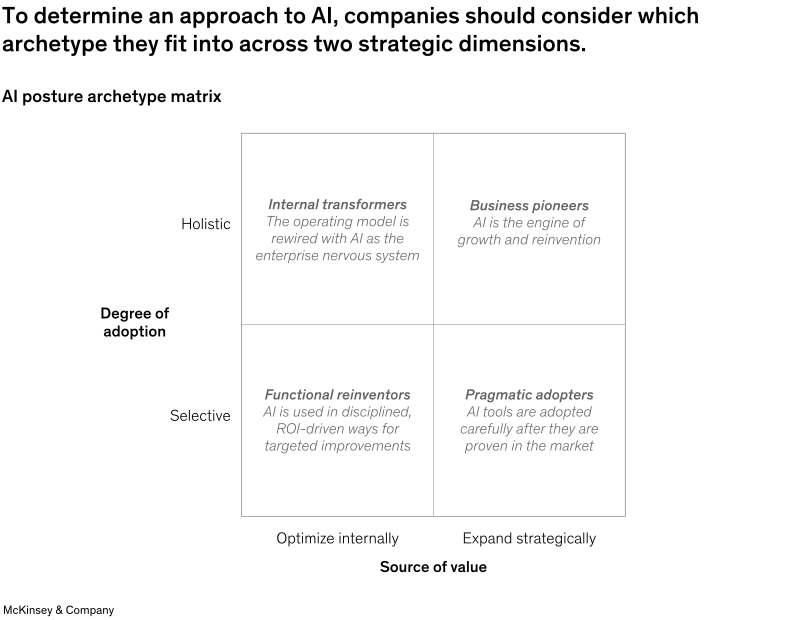
What matters is that the board aligns on the business’s aspirational strategy using a clear view of the opportunities and risks so that it can tailor the governance approach. As the business gains greater experience with AI, the board can modify its posture.
The four archetypes are as follows:
- Business pioneers. AI sits at the center of strategy, driving new offerings and redefining competition. Think of a medical-device company that could evolve from selling equipment to delivering AI systems that interpret scans and suggest appropriate treatments, thereby transforming from a manufacturer into a healthcare solutions provider.
- Internal transformers. AI becomes the backbone of operations, reshaping how an enterprise runs. An example of this archetype is a mining company deploying AI to guide exploration, automate extraction, and optimize refining—thereby transforming a labor- and asset-intensive model into a data-driven one. Similarly, a media studio could embed AI across its production pipeline, producing faster, cheaper content at scale.
- Functional reinventors. AI is used to enhance specific workflows with proven returns. Companies treat AI as a disciplined, ROI-driven investment rather than a reinvention lever. As an illustrative example, a healthcare system might adopt different AI scheduling, transcription, and workforce tools. Or a logistics provider could use route optimization and predictive maintenance to cut costs.
- Pragmatic adopters. AI is adopted for targeted applications based on already proven market traction. This is essentially a fast-follower approach. For example, a consumer goods company may wait until off-the-shelf e-commerce recommendation tools have been proved before adopting them to expand to new segments. Similarly, a fashion retailer might start leveraging AI to offer clothing rentals and personalized styling only after others in the industry have proved its effectiveness.
Tailoring oversight to support the AI posture
Once a company’s AI posture is clear, the board’s task is to calibrate its role to match the business’s aspiration. What is essential for a pioneer moving into new markets will differ from what matters to a pragmatic implementer watching competitors.
Board priorities vary by archetype—the interactive below provides an overview of how.
We have updated this previously published article to include the interactive with the archetype details. To receive a PDF of this article with this detailed view of the board activities for each archetype, please contact us.

Rewired, second edition
This updated edition offers brand-new insights into cutting-edge AI solutions—and what it takes to implement them—as well as the new economics of digital and AI transformations.
Business pioneers
When AI is the engine of growth, the board’s role is to ensure that executive leadership understands AI’s value potential and how to capture it. This foundation enables the board to collaborate with and provide direction to management to make informed strategic investments and assess whether it possesses the necessary leadership, capabilities, talent, and capital to deliver.
Directors should focus on determining whether management has the entrepreneurial experience, technological know-how, and transformational leadership experience to run an AI-driven business. The board’s role is particularly important in scrutinizing the sustainability of these ventures—including required skills, implications on the traditional business, and energy consumption—while having a clear view of the range of risks to address, such as data privacy, cybersecurity, the global regulatory environment, and intellectual property (IP).
This level of intervention will require a sufficient number of board members with product and broader AI experience, so they can act as thought partners and credible challengers to management.
Example: A global logistics company leveraged decades of trade data to develop a new AI-driven intelligence platform, transitioning from being a shipping provider to an information business. Support for the venture increased after the board validated defensible data moats, stable model performance under drift, and sustainable compute cost.
Boardroom test questions include the following:
- Which competitive advantages does AI enhance or threaten?
- Does our AI business case target a large enough value pool to reshape our market?
- What key resources are needed to do that, and do we currently have them?
- Do we have dedicated people who can manage the environmental, regulatory, legal, and reputational risks that come with being a business pioneer?
- How do we need to evolve our innovation pipeline to match the pace of technological change?
Internal transformers
For companies with the ambition to embed AI across their operations, the board’s role is to direct and oversee the rewiring of the operating model at scale. While all archetypes involve some operating-model changes, internal transformers stretch this across multiple functions in the enterprise—a uniquely complex challenge.
Boards play an important role in challenging management to certify that operational gains are structural rather than temporary and that they meaningfully improve the business’s productivity. This focus requires detailed knowledge of systems and dependencies, as well as the technological foundations (particularly enterprise architecture) that enable cross-functional process modernization.
Boards will need to be particularly diligent in probing resilience, observability, and explainability to certify that systems are stable, trackable, and quickly corrected as needed. The board’s task is to encourage management to balance ambition with adoption, making sure that the organization has a robust upskilling program and incentives aligned to the changes needed on the front line.
Example: One global manufacturer’s board questioned management about whether AI-driven planning, supply chain, and maintenance systems were interoperable and stress-tested before approving new capital. This helped ensure that the AI initiatives were resilient and could scale.
Boardroom test questions include the following:
- Is AI truly rewiring how this company operates or just automating isolated tasks?
- What evidence supports that the operational changes are both structural and sustainable?
- How confident is the management team that it can track and understand how AI is driving cross-functional processes?
- How should we shift our buy-versus-build approach to solidify our competitive advantage and our strategic flexibility?
Functional reinventors
For companies embedding AI into selective workflows, the board’s role is to focus on scaling for value, securing coherence across initiatives, and mitigating vendor-related risks. Board committees in specific areas, such as audit, risk, and talent, play a stronger role in driving AI workflow transformations within their respective domains.
Boards are focused less on the individual workflow modernization efforts and more on supporting management in allocating resources effectively, coordinating dependencies and governance issues across workflows, and determining which investments have the greatest application to a broad range of workflows (for example, developing data products that serve multiple workflows). Real-time dashboards can help boards track outcomes and progress.
Functional reinventors are more likely to buy than build, given the generally narrow focus on workflows. “Vendor lock-in” isn’t a new concern, but boards can play a critical role by probing management to explain how competitive advantage is being protected and to what degree it is being ceded to vendors. Some vendor decisions have long-term implications, such as maintaining internal support capabilities, which management should clarify.
Example: One regional healthcare system’s board now asks its CEO to present a consolidated map of all AI pilots each quarter, covering scheduling, transcription, and workforce tools. The board uses this review to challenge whether pilots are scaling effectively and whether weak pilots are being defunded quickly enough.
Boardroom test questions include the following:
- Which high-value workflows can most benefit from AI?
- How does management set the parameters to manage the risk posed by AI programs in specific workflows?
- What are the advantages and risks of buying versus building core capabilities?
- What is the mechanism for tracking and scaling the most promising workflow programs?
Pragmatic adopters
Boards of organizations that adopt a pragmatic approach toward AI should concentrate on strategic readiness and the risk of inaction. Board members can be most helpful by asking management to share and discuss market intelligence, including competitor moves, market shifts, and AI evolutions.
During these reviews, board members should be ready to constructively challenge management to clarify if and how these developments could threaten the business’s long-term competitiveness and enhance any aspects of the current business model. Boards can establish clear metrics and escalation procedures to track the maturity of relevant AI capabilities deployed by potential competitors, as well as conduct readiness assessments to ensure that the company has sufficient foundations and capabilities to move quickly when an AI opportunity presents itself.
Example: One energy company’s board devotes a portion of its annual strategy retreat to reviewing case studies of AI adoption from adjacent industries. Directors ask management to map the elements, including vendor partnership, capital allocation, and workforce readiness, it would require to catch up quickly if needed.
Boardroom test questions include the following:
- How are we tracking AI developments inside the industry, as well as with competitors, to determine what actions we should take?
- Do we have a credible plan to follow fast on a proven AI capability, and how do we assess our readiness to move?
- What are the risks associated with not pivoting in time in various business areas?
Six actions to take
Our research highlights six actions that boards should consider taking, with the degree of pursuit varying per their AI posture:
- Align on AI posture and review it annually (at least). The first order of business is to align on what posture the business should take with AI—without that clarity, none of the other actions matter. Boards should then regularly revisit their AI posture in response to changes in the competitive, regulatory, and technological environments. Proactive posture reviews make sure that the company’s stance reflects today’s realities rather than yesterday’s assumptions. This annual review shouldn’t replace more frequent engagement on the topic (see action 4).
- Clarify ownership of AI oversight—within both the board and management. Oversight fails without clear accountability. Boards should explicitly define which topics should be reviewed and fully discussed in full-board sessions (for example, material investments to scale enterprise-wide AI), which belong in committees (for example, risk frameworks and material vendor reviews), and which do not require significant board discussion (such as regular operational decisions). Without this specificity, ambiguity emerges and accountability breaks down or precious agenda time is wasted.
-
Codify a framework for AI governance policy. Most companies draft principles or ethics statements, but fewer than 25 percent of companies have board-approved, structured AI policies.7 A credible governance framework should specify the following:
- scaling rules (when pilots earn capital to scale enterprise-wide)
- risk thresholds (where human sign-off is necessary and what guardrails should be in place)
- vendor or data guardrails (IP protections, third-party audit rights, security, and lineage standards)
- escalation triggers (what incidents reach the board and how fast)
- Engage more broadly (and frequently) with those doing the work. It is not enough to engage only with CEOs or CFOs on AI developments in the business. Board directors should be regularly exposed to and interact directly with the executives who are embedding AI into operations (such as chief data and analytics officers and business and division leaders) to gain a deeper understanding of progress against goals and impact on competitive dynamics.
- Tie AI investment to business value. Boards should encourage management to not only identify but also quantify the potential opportunities and risks associated with AI adoption. This view can help boards guide businesses through the short- and long-term trade-offs that balance opportunity and risk, using their AI posture. Effectively providing that guidance requires solid reporting, but only about 15 percent of boards currently receive AI-related metrics.8 Boards should have access to impact measures such as ROI by business unit, percentage of processes that are AI enabled, resilience indicators (such as override rates and backup drill results), workforce-reskilling progress, and regulatory alignment. This information helps reframe AI strategic direction and oversight in a similar way to capital allocation and risk reviews.
- Build AI fluency. Directors do not need to be data scientists or deep-tech experts, but they do need to have a sufficient understanding of how AI works and its role in creating opportunities and risks for the business. Building up that base of knowledge happens through ongoing education, regular briefings, external trainings, advisory panels, and input from external experts on emerging technologies, regulations, and risks. Board members should become comfortable with AI by using it in their personal lives, to prepare for meetings, to review publicly available information, and to run analyses on proprietary information only in ways approved by the general counsel.
As boards consider what steps to take, they might consider some of the operating practices for venture capital and private equity companies. Those companies typically have a clearer view and focus on the value opportunities with AI, stronger accountability measures, and a faster operating metabolism, such as with funding decisions.
The rules, risks, and expectations related to AI are evolving rapidly, and boards cannot assume today’s practices are sufficient to meet the new challenges and opportunities. Boards will need to evolve to match the pace and scope of change that AI promises while maintaining their traditional focus of providing strategic direction and oversight to senior management to create value and mitigate risk.