For governments around the world, infrastructure development is a pressing priority to provide energy and transport to drive economic growth, build thriving modern cities, and meet social needs.1 Budgets reflect this: Infrastructure investment commands around 7 percent of GDP in many countries (excluding real estate).2 McKinsey Global Institute estimates that, to keep pace with projected GDP growth, the world needs to invest as much as $3.7 trillion in economic infrastructure every year until 2035.3
When approached effectively, infrastructure development can dramatically boost GDP, improve citizens’ quality of life, and attract significant private investment. However, governments often struggle to align their infrastructure plans with population growth and economic projections.
Major infrastructure projects can be marred by cost overruns and wasteful spending, arising from siloed sectors and regions that do not share data or coordinate planning. This fragmentation can lead to delays, resource misallocation, infrastructure bottlenecks, and regional disparities. For instance, inadequate coordination between transportation and urban development authorities can lead to poorly connected transit networks.
Governments can overcome this lack of coordination by adopting integrated, best-in-class strategies to unlock the full value of their infrastructure investments. In this article, we examine four ways by which governments can potentially optimize infrastructure planning: embracing a high-level infrastructure plan; streamlining governance processes; providing clear structures and mechanisms to proactively engage private sector contribution; and adopting technology, including AI.
Our benchmarking methodology
When analyzing the current state of infrastructure governance, we identify pain points and benchmark against global best practices in infrastructure planning and governance. This involves assessing different governments’ operations; how they plan, coordinate, and select infrastructure projects; how they manage their budgets; and how they structure their private sector-bid management frameworks.
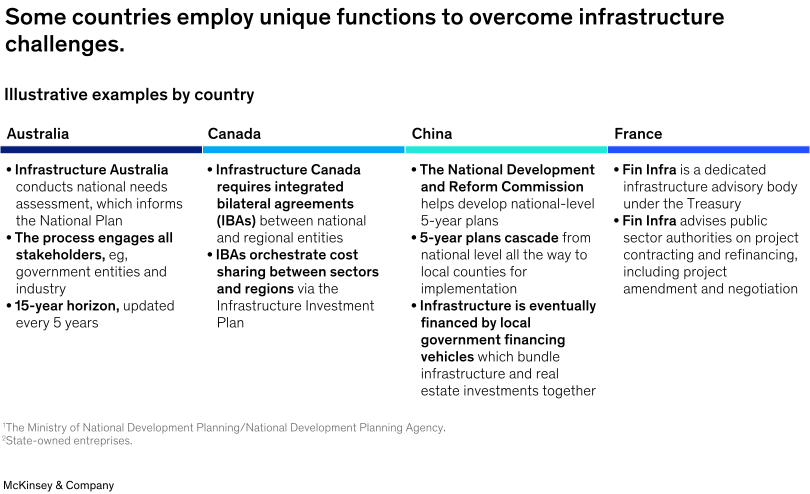
In this article, we highlight governments that excel in these specific areas and those that have found innovative solutions to infrastructure challenges (exhibit). However, we have observed that even where governments excel in one or two areas, they still face challenges in others. To be truly best-in-class, governments need to optimize across all dimensions.
The prize is worth the effort, as we have observed from several governments that have updated their infrastructure plans (see sidebar “Our benchmarking methodology”). Infrastructure optimization has reduced unnecessary overinvestment, decreased misallocation across sectors and regions, and identified private investment opportunities, potentially funding up to 50 percent of infrastructure capital expenditure (capex).4
Reevaluating infrastructure plans
Effective infrastructure planning is crucial for governments that aim to spend their budgets productively. Often, there is a moment of truth that prompts them to reevaluate their infrastructure plans. These moments could be triggered by the launch of a new economic development plan; hosting mega events such as a sports World Cup; significant infrastructure investments, such as transitioning to renewable energy; or large-scale real estate developments.
To remain agile and proactive, while ensuring efficient budget allocation, governments need to have a robust infrastructure plan—outlining both the short- and long-term visions and a strategic framework for managing a region’s infrastructure.
Governments that lead in infrastructure planning build a comprehensive, cross-sectoral plan, with a unified approach and methodology, to better estimate infrastructure investment needs. This plan is periodically updated to ensure that it reflects the latest thinking in this space. For example, Malaysia develops a detailed national plan every five years that sets goals for critical infrastructure. The country’s National Planning Committee (NPC) formulates the framework, which is then used by the Economic Planning Unit (EPU) that oversees the development planning process and collates input from interagency planning groups and technical working groups.
To ensure accurate sector-specific planning and effective integration across sectors, governments can develop detailed sectoral or regional strategies, including infrastructure plans. At the same time, they can establish feedback loops and a cross-cutting integration layer—such as shared data standards, coordinated planning forums, and joint investment mechanisms—to drive effective planning and alignment.
A successful infrastructure plan integrates several critical elements to ensure that the entire process is effective across different government entities.
1. Unified infrastructure definitions
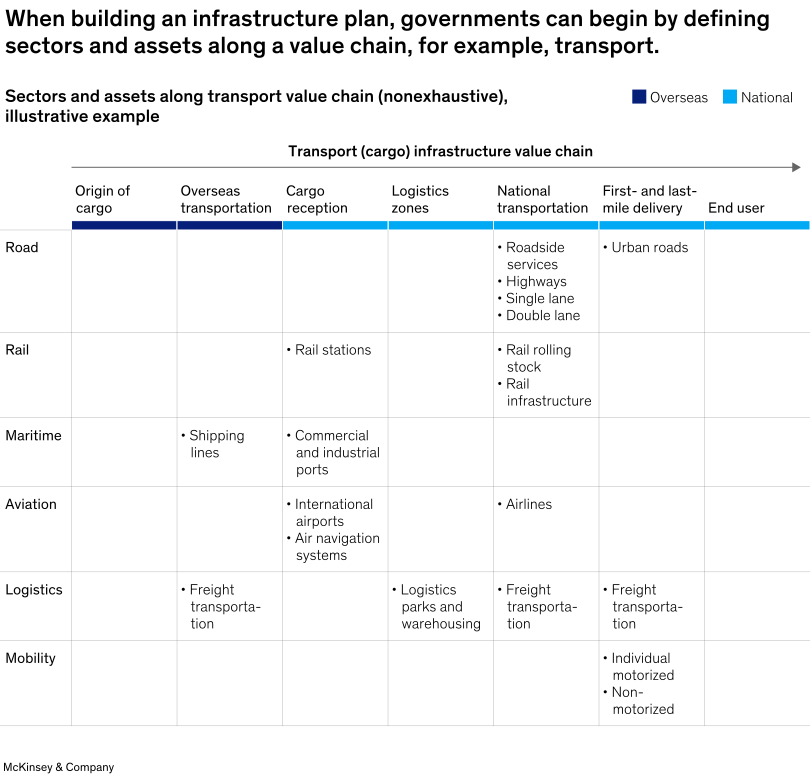
When building these plans, governments can begin by defining the different sectors in government and the different assets along the value chain of each sector. These could be infrastructure asset groups in transport (such as roads and airports), utilities (including power, water and waste, and telecom), and social infrastructure, including education, among others (Exhibit 1).
2. A diagnostic assessment of the current infrastructure plan
Once the infrastructure landscape has been mapped out, a diagnostic review of existing infrastructure strategies can be done through an on-the-ground evaluation, assessing coordination, private sector involvement, and sector-specific planning approaches. This methodology typically starts with a thorough evaluation of the current state of assets across all sectors, including their capacity, utilization, and quality. In this way, governments can identify gaps and opportunities for improvement.
3. Standardized planning parameters and forecasting methods
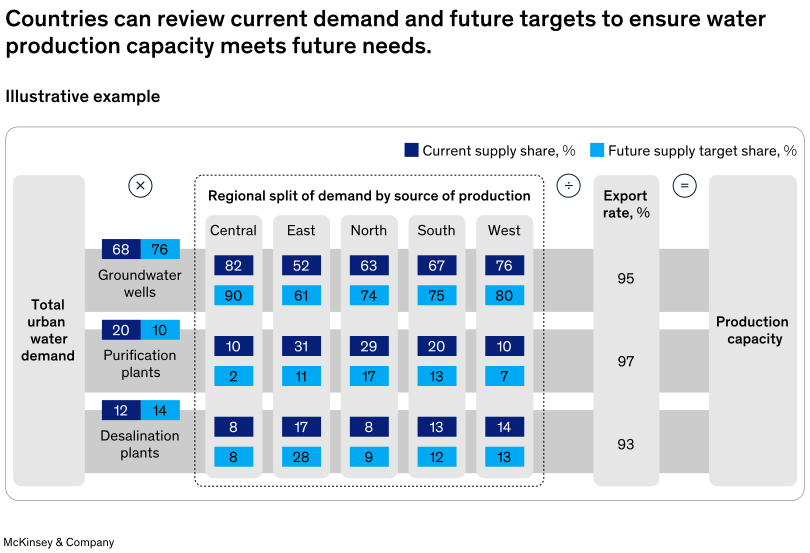
Planning parameters (such as population and GDP forecasts, urban development patterns, and economic activity) can be standardized across government entities to ensure alignment across all sectors and assets. Once these common assumptions have been developed, demand forecasting across sectors can begin, incorporating sector-specific inputs (including reserve margins, renewable energy mix, and water consumption per capita). When determining future capacity needs, governments can consider current and target utilization rates, alongside the projected demand forecasts for each sector. Examples include water, waste, and power:
- Water. Governments can determine total future demand based on population forecasts and projections of consumption per capita, taking into consideration water loss and a buffer. Water infrastructure is complex and should be evaluated along the entire value chain: production, storage, transmission, distribution, wastewater collection, and wastewater treatment (Exhibit 2). Additional demands from tourism and industrial development also need to be considered.
- Waste. Demand for landfills is driven by waste production per capita estimates, with many governments aiming to reduce this target. Often, landfill requirements are compared to existing available landfill spaces, without including open dumpsites as part of capacity. To reduce landfill requirements, governments can consider increasing recyclable waste by sorting more waste at landfills and introducing penalty fees if waste producers do not recycle.
- Power. Forecast demand is based on development models and driven by GDP growth.5 Future capacity needs are evaluated across the value chain: generation, transmission, and distribution. For example, required generation capacity is driven by demand forecasting based on projected peak demand and generation reserve margins, as well as an additional margin to account for flexibility needs.
4. Investment calculation
Once capacity needs for each sector have been calculated, governments can determine the required investment. Following best practice, unit costs are applied for each sectorial infrastructure investment by asset class to derive the total investment requirement (that is, infrastructure ratios are developed to estimate the required investments based on previous investments or benchmarks). For road investments, for example, investment ratios (dollar per kilometer [$/km]) are estimated across lane expansions to cope with increasing demand, preventive maintenance investments to keep an adequate road quality level, and regular routine maintenance to ensure efficient and safe operation.
At this stage, investments are differentiated between public sector investments, such as public schools; public–private partnerships, such as toll roads; and pure private investments, such as private hospitals.
Streamlining governance to move from planning to execution
Once the national planning framework has been updated, the framework needs to be implemented across government entities, ensuring that each sector and region incorporates it into their investment planning functions. We have benchmarked best practices across nine countries in six key fields to see how governments achieve consistency6:
- Ensuring accurate data. A single source of truth for data that aggregates and analyzes infrastructure project metrics is vital to ensure that the entire government has a clear and honest picture of the investment landscape. For example, Malaysia’s Department of Statistics consolidates and disseminates government-collected data from various sources to enhance transparency, coordination, and data-driven decision-making.
- Establishing a long-term financial envelope. To support long-term economic growth and strategic development, governments can assign a long-term infrastructure budget. Australia’s Infrastructure Australia initiative follows this approach with its National Plan, which looks forward 15 years and is updated every five years.7
- Prioritizing the right projects. By adopting sector-agnostic metrics, governments can prioritize infrastructure projects, using standardized evaluation criteria such as benefit-cost analysis on a net present value (NPV) basis. As an example, Indonesia’s National Development Planning Agency (NDPA) is a central government organization responsible for national development planning and budgeting. The NDPA has a robust prioritization mechanism to classify a pipeline of projects based on funding availability, updated every four years.
- Ensuring project feasibility. Some governments offer expert perspectives to pressure-test technical projects and analyze project feasibility, for example, through a center of excellence. France’s Fin Infra implements a stage-gate evaluation approach, reassessing the necessity and viability of a project at critical milestones to ensure continued relevance and alignment with evolving needs and priorities.
- Encouraging partnerships. Bilateral agreements between central governments and regions allow them to partner in cost sharing and delivery. Take Canada, for example, where Infrastructure Canada uses bilateral agreements to distribute infrastructure funding across sectors and regions. A unique aspect of Canada’s national–regional coordination is the online publication of project pipelines and awarded projects, accessible to the public.
- Maintaining an active feedback loop. By overseeing project implementation and maintaining a feedback loop, governments can proactively intervene if needed. Again, in Canada, post-completion analyses are conducted to evaluate project outcomes, with key insights fed back into the next planning cycle.
Proactively sourcing private sector contributions
Governments sometimes miss out on opportunities to attract funding from private investors, which is abundant—worldwide, in 2024, private infrastructure assets under management surged from about $500 billion in 2016 to $1.5 trillion.8
Some governments take a proactive approach to engage the private sector in infrastructure financing by assessing and identifying public infrastructure projects suitable for private sector involvement. This makes the process as easy and accessible to the private sector as possible and allows early engagement to maximize investment opportunities. The United Kingdom has embraced this approach, and approximately 50 percent of UK infrastructure projects are now privately financed.9
Unlocking this level of private sector contribution requires enhanced market transparency—including clear stakeholder landscapes and accessible data—standardized policies, regulatory clarity, and financial incentives. Governments can create a unified platform or centralized digital hub for all government initiatives to enhance transparency by providing real-time updates on policies, incentives, and regulations. This focal point for investors reduces information asymmetry, streamlines communication, and encourages greater private sector engagement in market opportunities.
Enhanced regulatory predictability and clear compliance criteria are attractive for the private sector. By governments streamlining policies and approval processes through clearer regulations, standardized procedures, and digitalization, efficiency can be improved and bureaucratic barriers reduced.
Additionally, governments can use innovative public–private partnership (PPP) models to drive investments. In France, a dedicated agency, FIN INFRA, advises all public sector authorities on best-practice PPP contracting, including how to structure projects and how to effectively negotiate concessions and contracts.
Private sector participation in infrastructure development can be encouraged with models such as the Build–Operate–Transfer (BOT) model or Design–Build–Finance–Maintain–Operate (DBFMO) model (see sidebar “Two PPP models that can encourage investment”).
Private sector contribution to infrastructure investment can be significant, particularly in sectors such as telecoms, where the benchmarking average is approximately 85 percent, and in power, where it is approximately 66 percent. Investment is considerably lower in other sectors, notably in transport infrastructure (about 22 percent) and industrial zones (about 7 percent).10
Adopting technologies to optimize infrastructure planning
As technology transforms infrastructure and infrastructure planning, governments stand to gain by embracing technological advances. There are multiple uses for technology in infrastructure, such as harnessing data and AI to optimize asset performance and maintenance, using automation and robotics in construction for better productivity and cost savings, and employing AI and machine learning to optimize and automate procurement processes.
Technology can be used to optimize the infrastructure planning process. For example, AI tools enable faster and more accurate alignment of infrastructure plans and can quickly identify gaps or inconsistencies, allowing planners to address issues proactively.
Digital twins and virtual simulations work well in planning processes by providing risk-free environments in which to test scenarios, optimize designs, and predict outcomes, leading to better planning and reduced costs. By creating accurate digital representations of physical assets, stakeholders can visualize potential issues and make informed decisions before actual implementation.
Singapore has made effective use of this technology by developing a comprehensive 3D digital twin known as Virtual Singapore, integrating real-time data from various sources, including buildings, infrastructure, and environmental factors. The platform enables urban planners to simulate infrastructure scenarios, optimize land use, and improve resource allocation. It also enhances disaster preparedness by predicting potential vulnerabilities and supports sustainable development initiatives.
Geographic information systems (GISs) play a crucial role in infrastructure planning. This technology provides spatial data analysis, mapping capabilities, and real-time insights. GIS enables urban planners to visualize land use, assess environmental impact, and optimize infrastructure placement. For example, the US city of Portland, Oregon, used GIS to balance urban expansion with environmental conservation. The technology helped identify suitable development areas, while pinpointing ecologically sensitive regions for conservation.
Effective infrastructure planning and execution are essential in achieving long-term economic growth, efficient resource allocation, and sustainable service delivery. The issues that governments face are universal—but the strategies to address them are tailorable. By embracing innovation and adaptability, governments can ensure their infrastructure plans meet current demands and drive growth for the future. With concerted effort, and by following a tried-and-tested methodology, governments can achieve best-in-class infrastructure planning, thereby unlocking economic and social benefits for generations to come.